


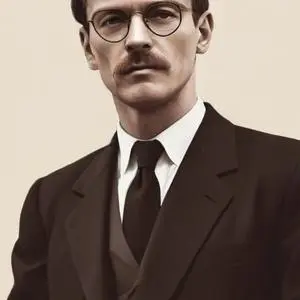
A pioneering writer of the early 20th century, known for exploring themes of human nature, relationships, and the clash between individual desire and societal expectations through novels like "Sons and Lovers" and "Lady Chatterley's Lover".
D. H. Lawrence, the renowned English novelist, poet, and playwright, is best known for his provocative and pioneering works that challenged the conventional norms of literature and society. His novels, such as The Rainbow, Women in Love, and Lady Chatterley's Lover, are iconic for their unapologetic exploration of human sexuality, vitality, and instinct.
Born on September 11, 1885, in Eastwood, Nottinghamshire, Lawrence grew up in a working-class family, with his father working as a barely literate miner and his mother, a former pupil-teacher, struggling to make ends meet. This tumultuous upbringing provided the fertile ground for his later works, which often dwelled on the tensions between social classes and the struggle for individuality.
Lawrence's writing was deeply rooted in his philosophy of life, which emphasized the importance of instinct, passion, and individual freedom. He believed that modern society was suffocating under the weight of industrialization and mechanization, and that people needed to reconnect with their primal selves to truly live. This philosophy is reflected in his works, which often chronicled the struggles of characters torn between their natural desires and the constraints of society.
Lawrence's unflinching portrayals of human sexuality and his critique of societal norms led to widespread controversy and censorship during his lifetime. His novels were often banned or censored, and he was vilified by the press and the public. Despite this, he remained unwavering in his artistic vision, continuing to write works that challenged the status quo.
Lawrence's work has had a profound impact on modern literature and society. His emphasis on individual freedom, sexual liberation, and the importance of instinct has inspired generations of writers, artists, and thinkers. His influence can be seen in the works of authors such as E. M. Forster, Tennessee Williams, and Allen Ginsberg, among many others.
D. H. Lawrence died on March 2, 1930, at the age of 44, but his legacy lives on. His works continue to be widely read, studied, and debated, and his influence can be seen in literature, art, and popular culture. Despite the controversies that surrounded him, Lawrence remains one of the most important and innovative writers of the 20th century.
Born in 1879
This celebrated author crafted novels and plays that probed the human condition, exploring themes of social class, morality, and personal relationships, with a distinctive wit and insight. Their works continue to captivate audiences with their nuanced portrayals of English society during the early 20th century.
Born in 1885
A pioneering writer of the early 20th century, known for exploring themes of human nature, relationships, and the clash between individual desire and societal expectations through novels like "Sons and Lovers" and "Lady Chatterley's Lover".
Born in 1882
A pioneering author of modernist literature, known for experimental novels and essays that explored the human experience, blurring the lines between reality and fiction.
Born in 1882
A pioneering modernist writer, known for experimental novels and short stories that explore the human experience, particularly in Dublin, Ireland. His works are celebrated for their complex, lyrical prose and innovative narrative structures.
Born in 1873
A pioneering modernist writer, credited with influencing 20th-century literature through experimental novels and poetry that explored the human condition. Known for his impressionistic style and complex characters.
Born in 1885
A pioneering modernist poet and critic who transformed 20th-century literature with innovative styles and provocative ideas, shaping the course of modern poetry.
Born in 1888
A renowned poet, playwright, and critic who reshaped modern poetry with works like "The Waste Land" and "Old Possum's Book of Practical Cats", influencing literature and art with their unique style.
Born in 1896
Author of novels and short stories that capture the essence of the Jazz Age, exploring themes of wealth, class, and the American Dream. Known for timeless classics like "The Great Gatsby" and "Tender Is the Night".
