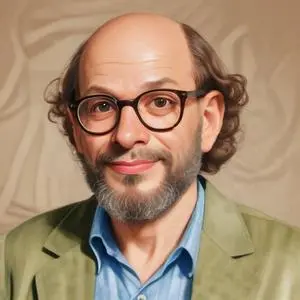
Allen Ginsberg: The Beat Generation's Iconic Poet and Counterculture Icon
A Voice Against Conformity
Allen Ginsberg is best known for his provocative poem
Howl, a scathing critique of 1950s America that denounced the destructive forces of capitalism, conformity, and sexual repression. This poem, along with his unapologetic views on drugs, sex, and multiculturalism, solidified his position as a leading figure of the Beat Generation.
The Birth of a Counterculture Icon
Born on June 3, 1926, in Newark, New Jersey, Ginsberg's early life was marked by turmoil and instability. His mother, Naomi, was a Marxist and a communist, while his father, Louis, was a poet and a teacher. This contrasting upbringing laid the foundation for Ginsberg's later rebellion against mainstream American culture.
Friendships and Influences
Ginsberg's student days at Columbia University in the 1940s were pivotal in shaping his future. It was during this time that he befriended Lucien Carr,
William S. Burroughs, and
Jack Kerouac, forming the core of the Beat Generation. These relationships not only influenced his writing but also instilled in him a sense of nonconformity and a desire to challenge the status quo.
The Trial of Howl
In 1956, San Francisco police and US Customs seized copies of
Howl, deeming it obscene due to its graphic language and descriptions of heterosexual and homosexual sex. The subsequent trial in 1957 attracted widespread publicity, with Judge Clayton W. Horn ultimately ruling that the poem was not obscene. This landmark case cemented Ginsberg's status as a champion of free speech and a beacon of hope for the marginalized.
Buddhism and Eastern Religions
Ginsberg's spiritual pursuits led him to extensively study Eastern religious disciplines, particularly Tibetan Buddhism. Under the guidance of Chgyam Trungpa, the founder of the Naropa Institute, Ginsberg deepened his understanding of Buddhist principles. This spiritual exploration not only influenced his writing but also shaped his views on materialism, consumerism, and the human condition.
A Life of Activism and Protest
Throughout his life, Ginsberg was an vocal critic of various social and political issues. He actively participated in protests against the Vietnam War, the war on drugs, and other injustices. His poem
September on Jessore Road drew attention to the plight of refugees fleeing the 1971 Bangladeshi genocide, exemplifying his commitment to using his voice to raise awareness about pressing global concerns.
Legacy and Impact
Allen Ginsberg's contributions to literature, counterculture, and social activism are immeasurable. His poetry continues to inspire generations of writers, artists, and free thinkers. As a pioneering figure of the Beat Generation, Ginsberg's unflinching commitment to nonconformity, free speech, and social justice has left an indelible mark on modern society.
Personal Relationships and Anecdotes
Ginsberg's personal life was marked by long-term relationships, including his lifelong partnership with Peter Orlovsky. The two men met in 1954 and remained together until Ginsberg's passing in 1997. This relationship, along with his connections with other notable figures like
Neal Cassady and
Gregory Corso, adds depth and complexity to our understanding of the man behind the poetry.
Controversies and Public Perception
Ginsberg's unapologetic views on sexuality, drugs, and politics often put him at odds with mainstream America. However, his unwavering commitment to his art and his values has earned him a revered place in literary and cultural history.
Awards and Honors
Ginsberg received numerous awards and honors for his work, including the National Book Award for his poetry collection
Collected Poems 1947-1980. His contributions to American literature have been recognized and celebrated by scholars, critics, and readers alike.
Quotes and Memorable Sayings
- "I saw the best minds of my generation destroyed by madness, starving hysterical naked."
- "Whoever controls the media, the images, controls the culture."
- "America, I'm puttin' my queer shoulder to the wheel."
Historical Context and Legacy
Allen Ginsberg's life and work serve as a testament to the power of creative expression and nonconformity. As a beacon of hope for those marginalized by society, his poetry continues to inspire and challenge readers. As we reflect on his life and legacy, we are reminded of the importance of speaking truth to power and embracing our differences.