


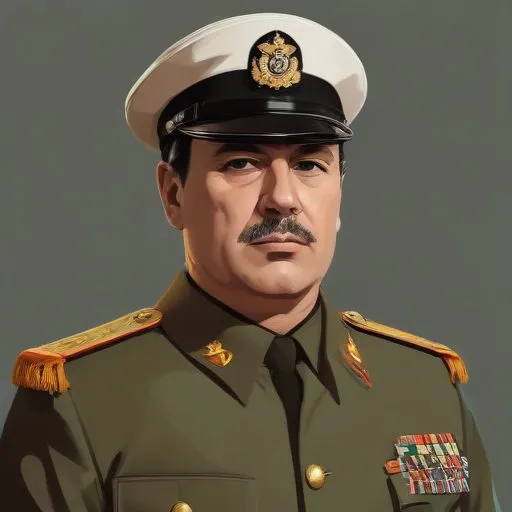
A Chilean military officer who led the 1973 coup against President Salvador Allende, marking a pivotal moment in Chile's history. He played a key role in the country's transition to a military dictatorship.
Alejandro Gorostiaga is renowned for his pivotal role in the War of the Pacific, where he led the Chilean Army to victory in the Battle of Huamachuco, crushing Peruvian forces and securing Chile's triumph in the conflict. This military genius is celebrated for his bravery, strategic prowess, and unwavering dedication to his country.
Alejandro Gorostiaga was born on May 12, 1840, in La Serena, Chile, to a family of Basque descent. In 1857, he enrolled in the Escuela Militar de Chile, where he honed his military skills and developed a strong sense of discipline and patriotism. After completing his studies, Gorostiaga rose through the ranks, eventually becoming a colonel in the Chilean Army.
In 1879, Chile declared war on Peru and Bolivia, and Gorostiaga joined the fight. As commandant of the civic battalion Coquimbo N1, he played a crucial role in the Battle of Pisagua. However, it was his masterful leadership in the Battle of Huamachuco on July 10, 1883, that cemented his reputation as a military genius. Gorostiaga's strategic decision-making and bravery in the face of overwhelming odds led to the defeat of Andrs Cceres' Peruvian forces, securing a decisive victory for Chile.
Alejandro Gorostiaga's contributions to Chile's military triumph in the War of the Pacific have had a lasting impact on the country's history and national identity. His bravery, strategic thinking, and unwavering commitment to his country have inspired generations of Chileans. Today, Gorostiaga is remembered as one of Chile's most celebrated military heroes, and his legacy continues to shape the country's military traditions and national pride.
Gorostiaga's personal relationships and anecdotes are scarce, but it is known that he was a devoted family man and a loyal friend to his comrades-in-arms. His commitment to his country and his people was unwavering, and he remained humble and unassuming despite his many accolades.
Alejandro Gorostiaga's life and military career are inextricably linked to the War of the Pacific, a conflict that shaped the course of Chilean history. His bravery, strategic thinking, and leadership skills have made him an enduring symbol of Chile's military might and national pride. As a historical figure, Gorostiaga's legacy continues to inspire and educate future generations, cementing his place in the annals of Chilean history.
Born in 1915
Chile's authoritarian leader from 1973 to 1990, known for his military coup and human rights abuses, as well as implementing free-market economic policies.
Born in 1908
Chile's first democratically elected Marxist president, who implemented radical socialist reforms and nationalized key industries, but was overthrown in a CIA-backed coup.
Born in 1918
Chile's first democratically elected president after Pinochet's dictatorship, he led the country's transition to democracy and implemented human rights reforms. He's known for his key role in Chile's return to democracy.
84 Years Old
Chile's 32nd President, a skilled engineer and politician, led the country's transition to democracy after Pinochet's rule, implementing economic reforms and infrastructure development. He's known for his commitment to social justice and human rights.
88 Years Old
A champion of democracy and social justice, he led Chile's transition from dictatorship to democracy, implementing reforms to reduce poverty and inequality.
75 Years Old
First female President of Chile, championing human rights and social justice, particularly for women and children.
76 Years Old
Chile's first billionaire president, known for his market-oriented economic policies and controversial handling of social unrest.
Born in 1877
A Chilean general and politician who served as the 20th President of Chile, known for his authoritarian rule and modernization efforts. He's remembered for his significant impact on Chile's economy and politics.
