


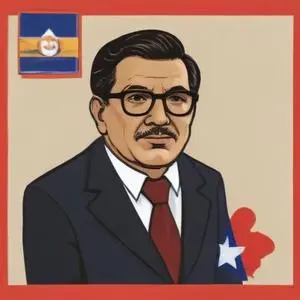
Chile's first democratically elected Marxist president, who implemented radical socialist reforms and nationalized key industries, but was overthrown in a CIA-backed coup.
Salvador Allende, the 28th President of Chile, is revered as the first Marxist to be democratically elected in a liberal democracy in Latin America. His unwavering commitment to socialism and democracy earned him a place in history as a champion of the working class and a beacon of hope for the marginalized.
Allende's involvement in Chilean politics spanned nearly four decades, during which he held various positions, including senator, deputy, and cabinet minister. His dedication to the Socialist Party of Chile, which he helped found, was unshakeable, and he ran for the national presidency three times before finally securing the top seat in 1970.
As president, Allende pursued a policy he called "The Chilean Way to Socialism," which aimed to nationalize major industries, expand education, and improve the living standards of the working class. His vision was to create a more equal society, where the means of production were controlled by the people, not a privileged few.
Allende's government implemented radical reforms, including the nationalization of copper mines, the establishment of a state-run banking system, and the redistribution of land to peasant farmers. These measures, although popular among the working class, sparked controversy among the right-wing parties that controlled Congress and the judiciary.
On September 11, 1973, the military, backed by the CIA, launched a coup d'état, ending Allende's government and his life. The brutal events of that day continue to cast a shadow over Chilean politics and international relations.
Despite his tragic demise, Allende's legacy lives on, inspiring generations of socialists, democrats, and human rights activists around the world. His courage in the face of adversity, his commitment to democracy, and his unwavering belief in the power of the people to shape their own destiny will forever be remembered.
Allende's philosophical framework was rooted in democratic socialism, which emphasized the role of the state in promoting social welfare and regulating the economy. He believed in the power of collective action and the importance of grassroots participation in shaping policy.
Allende's ideals continue to influence modern society, from the Podemos movement in Spain to the Bolivarian Revolution in Venezuela. His commitment to social justice, democracy, and human rights has inspired a new generation of politicians and activists.
"The people must be the protagonist of their own history." - Salvador Allende
"I will not resign. I will not betray the trust of the people." - Salvador Allende, in his final address to the nation
Allende's presidency marked a turning point in Chilean history, as the country began to challenge the dominance of the capitalist elite and forge a new path towards socialism. His legacy continues to inspire and provoke, ensuring that his memory remains a powerful symbol of resistance and hope.
Today, as the world grapples with the challenges of inequality, poverty, and climate change, Salvador Allende's vision of a more just and equitable society remains as relevant as ever, a beacon of hope in a world still struggling to find its way.
Born in 1926
The Cuban revolutionary who led the country from 1959 to 2008, implementing socialist policies and defying US opposition, becoming an iconic figure in modern history.
Born in 1904
A Chilean poet and diplomat who wrote passionate and evocative poetry that explored love, politics, and the human condition, and was awarded the Nobel Prize in Literature in 1971.
Born in 1915
Chile's authoritarian leader from 1973 to 1990, known for his military coup and human rights abuses, as well as implementing free-market economic policies.
Born in 1870
Founder of the world's first socialist state, leading the Bolshevik Revolution and establishing the Soviet Union, known for his radical Marxist ideology and authoritarian rule.
Born in 1878
The Soviet Union's ruthless leader who ruled with an iron fist, implementing policies that led to widespread famine and purges, while also playing a crucial role in defeating Nazi Germany in World War II.
Born in 1893
Leader of the Chinese Communist Party who implemented radical social and economic reforms, including the Great Leap Forward and the Cultural Revolution, shaping modern China's politics and economy.
72 Years Old
The charismatic leader who transformed Venezuela through socialist reforms and anti-imperialist rhetoric, leaving a lasting impact on the country's politics and economy.
66 Years Old
The first indigenous president of Bolivia, who served from 2006 to 2019 and implemented policies to reduce poverty and increase economic growth, while also being a strong advocate for indigenous rights.
