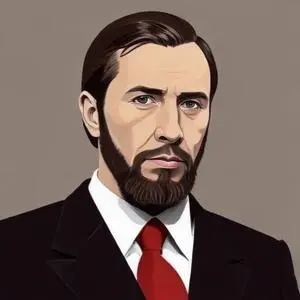
Aleksandr Dugin: The Russian Philosopher Behind Neo-Eurasianism
Aleksandr Dugin is a Russian far-right political philosopher, born on January 7, 1962, who has made a name for himself as a leading proponent of neo-Eurasianism, a political ideology that advocates for Russia's re-emergence as a global power. He is known for his controversial views, which have been characterized as fascist or neo-fascist, and has been referred to as "Putin's brain" by some in the foreign media, although the extent of his influence on the Russian government is disputed.
Early Life and Education
Born into a military intelligence family, Dugin's early life was marked by a strong sense of patriotism and anti-communist sentiment. During the 1980s, he became an anticommunist dissident, playing an active role in the opposition movement against the Soviet Union. He later pursued higher education, earning a degree in philosophy from Moscow State University.
Foundations of Geopolitics and Neo-Eurasianism
Dugin's seminal work, "Foundations of Geopolitics," published in 1997, laid the foundation for his neo-Eurasianist ideology. In this book, he outlines his vision for Russia's resurgence, calling for the country to rebuild its influence through strategic alliances and conquests, while challenging the rival "Atlanticist" empire led by the United States. He advocates for a multipolar world order, with Russia at the forefront, and has been critical of Western liberalism and its perceived threat to traditional Russian values.
Career Highlights and Major Works
Dugin's academic and professional career has been marked by several notable milestones, including:
- Co-founding the National Bolshevik Party with Eduard Limonov in 1993
- Founding the Eurasia Party in 2002
- Serving as an advisor to Gennadiy Seleznyov and Sergey Naryshkin, Chairmen of the State Duma
- Heading the Department of Sociology of International Relations at Moscow State University from 2009 to 2014
- Briefly serving as chief editor of the pro-Kremlin Christian Orthodox channel Tsargrad TV in 2015
- Being appointed as a senior fellow at Fudan University in China in 2019
- Currently directing the Educational and Scientific Center Ivan Ilyin Higher School of Politics at the Russian State University for the Humanities
Controversies and Public Perception
Dugin's views have been met with widespread criticism, with many labeling him as a fascist or neo-fascist. His comments on the 2014 Odesa clashes, in which he advocated for the bombing of Ukraine, led to his removal as head of the Department of Sociology of International Relations at Moscow State University. Additionally, his association with far-right groups and his perceived influence on the Russian government have raised concerns about his ideology's potential impact on modern society.
Philosophical Contributions and Beliefs
At the core of Dugin's philosophy lies a belief in the importance of preserving traditional Russian values and promoting a multipolar world order. He advocates for a return to a more authoritarian, nationalist form of government, which he believes is necessary to counter the perceived threat of Western liberalism. His ideas have been influential in shaping the discourse around Russian identity and foreign policy.
Impact on Modern Society
Dugin's influence on modern society is a topic of ongoing debate. While some argue that his ideas have had a significant impact on the Russian government's foreign policy, others suggest that his influence is exaggerated. Nevertheless, his neo-Eurasianist ideology has contributed to a shift in the global political landscape, with many countries now seeking to reassert their national identities in the face of perceived Western dominance.
FAQ
What are Aleksandr Dugins political views?
Aleksandr Dugin is a Russian political analyst and strategist known for his fascist and nationalist views, promoting a Eurasianist ideology.
What is Aleksandr Dugins role in Russian politics?
Aleksandr Dugin has been an influential figure in Russian politics, advising politicians and promoting his ideology through various media outlets.
What are Aleksandr Dugins writings and publications?
Aleksandr Dugin has written several books on geopolitics, philosophy, and ideology, including The Foundations of Geopolitics and The Fourth Political Theory.
Has Aleksandr Dugin been involved in controversies?
Yes, Aleksandr Dugin has been involved in controversies surrounding his views on Ukraine, liberalism, and human rights, as well as his support for authoritarian regimes.
What is Aleksandr Dugins academic background?
Aleksandr Dugin studied at Moscow State University and later earned a doctorate in philosophy from the Russian Academy of Sciences.