


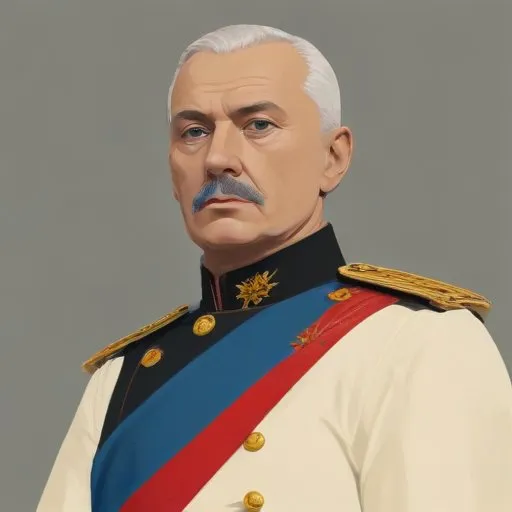
Led a series of successful Russian offensives during World War I, including the Brusilov Offensive, which was one of the most significant military campaigns of the war. He's also known for his innovative tactics and leadership style.
Aleksei Brusilov, a Russian general, is renowned for his innovative tactics that transformed the face of modern warfare, particularly during the 1916 Brusilov offensive, which remains one of the most significant military achievements in Russian history. His unorthodox approach to combat, which emphasized adaptability and flexibility, enabled the Russian army to gain a decisive upper hand against the Austro-Hungarian forces.
Born on August 31, 1853, in Tiflis, Georgia, Brusilov hailed from a distinguished military family. His father, Aleksi Nikolaevich Brusilov, was a Lieutenant General, and his mother, Anna Luiza Niestojemska, was of Polish descent. Orphaned at a young age, Brusilov was raised by relatives and went on to pursue a military career, graduating from the Pavlovsk Military School in 1872.
In 1916, Brusilov, then a cavalry officer, realized that traditional cavalry tactics were obsolete against modern weaponry. Undeterred, he developed a new approach that incorporated advanced artillery and air reconnaissance. This innovative strategy enabled the Russian army to achieve a series of stunning victories against the Austro-Hungarian forces, marking a significant shift in the balance of power.
Faced with the decline of the Imperial Russian Army, Brusilov defied expectations by siding with the Bolsheviks during the Russian Civil War. He played a crucial role in organizing the Red Army, applying his military expertise to help establish the new Soviet regime.
In 1924, Brusilov retired from active duty, but his legacy continued to influence Soviet military strategy and doctrine. His commitment to innovation and adaptability left an indelible mark on the Red Army, shaping its development in the decades that followed.
Aleksei Brusilov's contributions to military strategy and doctrine have been far-reaching, influencing generations of military leaders and thinkers. His emphasis on adaptability, flexibility, and innovation has become a cornerstone of modern military theory.
In conclusion, Aleksei Brusilov's life and career serve as a testament to the power of innovation and adaptability in the face of adversity. As a pioneering military strategist, he continues to inspire and influence military thinkers to this day, cementing his place as one of the most significant figures in Russian military history.
Born in 1870
A Russian general and explorer who led a failed coup against the provisional government in 1917 and was a prominent figure in the Russian Civil War. He's also known for his expeditions in Turkestan and the discovery of the ancient city of Khiva.
Born in 1857
A prominent Russian general who played a crucial role in the Russo-Japanese War and later became a key figure in the Imperial Russian Army during World War I. He's known for his military strategies and reforms.
Born in 1862
A Russian general who led the White Army against the Bolsheviks during the Russian Civil War, known for his attempts to capture Petrograd from the Reds.
Born in 1872
A Russian general who led the White Army against the Bolsheviks during the Russian Civil War, known for his attempts to restore the Russian monarchy.
