


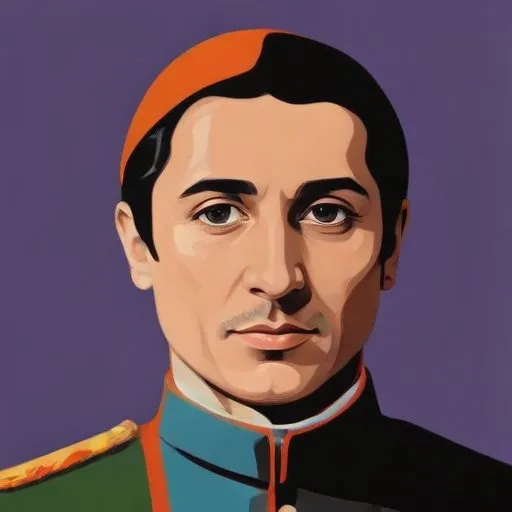
A renowned military leader and mercenary captain of the 15th century, known for his bravery and strategic prowess in battles across Italy.
Alessandro Sforza was an Italian condottiero, or military leader, and the lord of Pesaro, a city in the Marche region of Italy. Born in 1409, he was the first of the Pesaro line of the Sforza family, a powerful and influential dynasty in Renaissance Italy.
Alessandro was the illegitimate son of Muzio Attendolo Sforza, a famous condottiero. He collaborated actively with his brother Francesco in his military campaigns, and together they conquered several cities, including Milan, Alessandria, and Pesaro. In 1435, Alessandro won the battle of Fiordimonte, where the rebel leader Niccolò Fortebraccio was killed.
In 1444, Alessandro obtained the lordship of Pesaro from Galeazzo Malatesta and began to renovate the Ducal Palace to conform to Renaissance standards. During his rule, he enlarged the palace and added new wings, making it a symbol of his power and influence.
Alessandro continued to fight alongside his brother Francesco, participating in several battles and campaigns. In 1442, he commanded the troops besieged by Pope Eugene IV's condottiero Francesco Piccinino at Assisi. Although he was forced to leave the city, he later proclaimed himself lord of Parma in 1446.
Alessandro married Costanza Varano, the daughter of Pietro Gentile I da Varano, in 1444, and had two children with her. After her death, he married Sveva da Montefeltro, the daughter of Guidantonio da Montefeltro, count of Urbino. He also had two illegitimate daughters, Ginevra and Antonia.
Alessandro died in 1473 from an attack of apoplexy. He was succeeded by his son Costanzo as lord of Pesaro. His legacy as a skilled military leader and ruler of Pesaro has endured for centuries, and his contributions to the Renaissance era continue to be remembered.
Alessandro Sforza's life and achievements serve as a testament to his bravery, military prowess, and vision for the Renaissance era. His legacy continues to inspire and fascinate historians and enthusiasts alike.
Born in 1452
Ruler of Milan who commissioned Leonardo da Vinci's famous painting, The Last Supper, and was a patron of the arts and architecture.
Born in 1401
The Duke of Milan, a powerful Renaissance leader, expanded his dominion through strategic marriages and military campaigns, fostering a cultural and artistic boom in 15th-century Italy.
Born in 1444
The ruler of Milan from 1466 to 1476, known for his cruel and tyrannical reign, marked by numerous assassinations and brutal suppression of opposition. He was also a patron of the arts, commissioning works from famous artists like Leonardo da Vinci.
Born in 1449
A 15th-century noblewoman who played a significant role in shaping the politics and culture of Savoy through her strategic marriages and patronage of the arts. She was a powerful and influential figure in her time, known for her intelligence, beauty, and strong will.
Born in 1474
Renowned for epic poems, particularly "Orlando Furioso", which masterfully blended chivalric romance and Renaissance humanism, influencing literature for centuries.
Born in 1469
Italian historian and philosopher who wrote "The Prince", a seminal work on politics and power that still influences modern leadership and governance today.
Born in 1475
A ruthless and cunning politician who rose to power in the Renaissance era through intrigue and military conquest, leaving a lasting legacy in politics and governance.
Born in 1487
A 16th-century Pope who commissioned Michelangelo to paint the Sistine Chapel's frescoes and was a patron of the arts, leaving a lasting impact on Renaissance art and architecture.
