


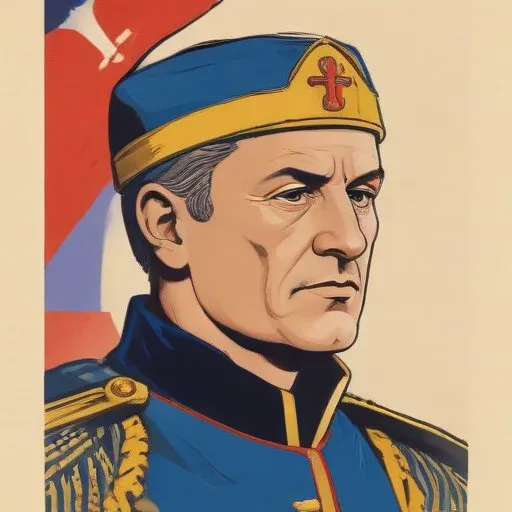
King of Yugoslavia from 1921 until his assassination in 1934, known for uniting the South Slavic nations into a single state. He played a key role in shaping the country's politics and economy.
Alexander I of Yugoslavia, also known as Alexander the Unifier, is renowned for his esteemed reign as the King of the Serbs, Croats, and Slovenes from 1921 to 1929, and subsequently as the King of Yugoslavia until his assassination in 1934. He is celebrated for his visionary leadership, which unified disparate regions into a single nation, earning him a prominent place in Yugoslavian history.
Born on December 16, 1888, in Cetinje, Montenegro, Alexander was the second son of Peter and Zorka Karaorević. His family had been ousted from power in Serbia 30 years prior, and Alexander spent his early years in exile with his father in Montenegro and later in Switzerland. He went on to enroll in the imperial Page Corps in Russia, where he received his education.
Following a coup d'état and the murder of King Alexander I Obrenović in 1903, Alexander's father became king of Serbia. In 1909, Alexander's elder brother, George, renounced his claim to the throne, making Alexander the heir apparent. He distinguished himself as a skilled commander during the Balkan Wars, leading the Serbian army to victory over the Ottomans and the Bulgarians. In 1914, he became prince regent of Serbia.
In 1918, Alexander oversaw the unification of Serbia and the former Austrian provinces of Bosnia, Croatia, and Slovenia into the Kingdom of Serbs, Croats, and Slovenes. He ascended to the throne upon his father's death in 1921. An extended period of political crisis followed, culminating in the assassination of Croat leader Stjepan Radić. In response, Alexander abrogated the Vidovdan Constitution in 1929, prorogued the parliament, changed the name of the country to the Kingdom of Yugoslavia, and established a royal dictatorship. The 1931 Constitution formalized Alexander's personal rule and confirmed Yugoslavia's status as a unitary state.
Alexander I of Yugoslavia was assassinated on October 9, 1934, in Marseille, France, while on a state visit. His death marked the end of an era and had significant repercussions for Yugoslavia's political landscape. Despite controversy surrounding his authoritarian rule, Alexander's vision for a unified nation continues to inspire generations, earning him a revered place in Yugoslavian history.
Born in 1923
The last king of Yugoslavia, ruling from 1934 to 1945, known for his attempts to maintain Yugoslav unity and resist Axis powers during World War II.
Born in 1892
Led the Yugoslav Partisans to victory in World War II and later became a unifying figure, serving as the President of Yugoslavia from 1953 to 1980. He's known for his unique blend of communist and nationalist policies.
