


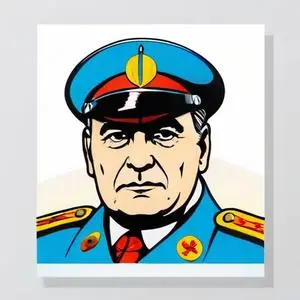
Led the Yugoslav Partisans to victory in World War II and later became a unifying figure, serving as the President of Yugoslavia from 1953 to 1980. He's known for his unique blend of communist and nationalist policies.
Josip Broz Tito, commonly known as Tito, was a Yugoslav communist revolutionary and politician who led the Yugoslav Partisans, one of the most effective resistance movements in German-occupied Europe during World War II. As the prime minister and later president of the Socialist Federal Republic of Yugoslavia, Tito's ideology and policies, known as Titoism, shaped the country's development from 1943 until his death in 1980.
Born on May 7, 1892, in Kumrovec, Austro-Hungary (now Croatia), Tito was the son of a Croat father and a Slovene mother. He was drafted into military service and distinguished himself, becoming the youngest sergeant major in the Austro-Hungarian Army of his time. During World War I, he was seriously wounded and captured by the Russians, after which he was sent to a work camp in the Ural Mountains.
While in Russia, Tito participated in some events of the Russian Revolution in 1917 and the subsequent Russian Civil War. Upon his return to the Balkans in 1920, he entered the newly established Kingdom of Yugoslavia, where he joined the Communist Party of Yugoslavia (KPJ). Tito assumed de facto control over the party by 1937 and was formally elected its general secretary in 1939 and later its president, a title he held until his death.
During World War II, after the Nazi invasion of Yugoslavia, Tito led the Yugoslav guerrilla movement, the Partisans (1941-1945). With the Allies' backing since mid-1943, the Partisans took power in Yugoslavia, and by the end of the war, they had become one of the most effective resistance movements in Europe.
After the war, Tito became the chief architect of the Socialist Federal Republic of Yugoslavia (SFRY), serving as prime minister (1944-1963), president (1953-1980), and marshal of Yugoslavia, the highest rank of the Yugoslav People's Army. He introduced a unique blend of socialism and nationalism, which earned him both admiration and criticism from the international community.
Tito's ideology, known as Titoism, was a blend of Marxism-Leninism and Yugoslav nationalism. He believed in a decentralized, self-managing socialist system, which gave more autonomy to Yugoslav republics and emphasized workers' self-management. Tito's pragmatism and willingness to adapt to changing circumstances earned him recognition as a shrewd politician.
Tito's legacy is complex and multifaceted. While he is revered as a national hero in Yugoslavia for his role in defeating Nazi occupation and establishing a socialist system, he has also been criticized for his authoritarian leadership style and human rights abuses during his presidency. Tito's balancing act between East and West during the Cold War earned him both admiration and suspicion from the international community.
"Unity in diversity" - Tito's famous phrase, which became the motto of Yugoslavia's federal system.
"I am a Yugoslav, and that is my country" - Tito's response to a question about his nationality.
Tito's life and legacy are closely tied to the tumultuous history of Yugoslavia and its place in the global Cold War landscape. His unique approach to socialism and nationalism continues to inspire debate among historians, politicians, and scholars. As a key figure in Yugoslav history, Tito's impact on the country's development and its eventual dissolution remains a subject of ongoing research and discussion.
In comparison to other communist leaders of his time, such as Stalin and Mao, Tito's approach to socialism was more pragmatic and adaptable. His willingness to engage with the West and maintain a degree of autonomy from the Soviet Union earned him a reputation as a shrewd and independent leader.
Tito's image has been immortalized in numerous films, books, and songs, cementing his status as a cultural icon in Yugoslavia. His charismatic personality and leadership style continue to inspire artists and writers to this day.
Born in 1881
A Yugoslav politician who served as the President of the Yugoslav National Assembly and played a key role in the country's unification and post-WWII reconstruction.
Born in 1910
A Slovene general, economist, and politician who played a key role in shaping Yugoslavia's post-WWII economy and foreign policy, and is known for his efforts to decentralize the Yugoslav government.
91 Years Old
Croatia's second president, a key figure in the country's independence and transition to democracy, known for his role in shaping modern Croatia's political landscape.
