


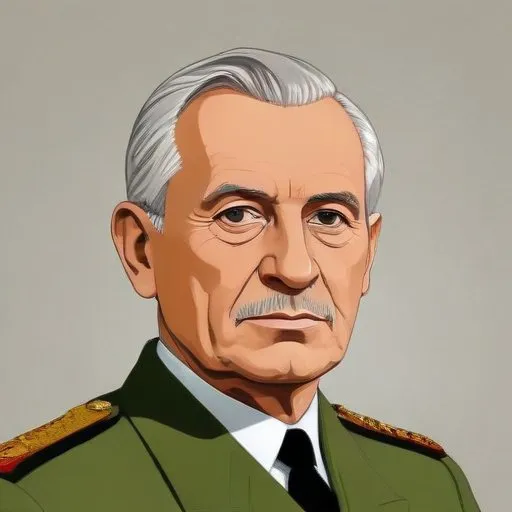
A Slovene general, economist, and politician who played a key role in shaping Yugoslavia's post-WWII economy and foreign policy, and is known for his efforts to decentralize the Yugoslav government.
Edvard Kardelj, a prominent Yugoslav politician and economist, is renowned for designing the innovative system of workers' self-management, a cornerstone of Yugoslavia's socialist economy. This pioneering concept, which empowered workers to manage their own factories and industries, not only redefined the country's economic landscape but also influenced socialist experiments worldwide.
Born on January 27, 1910, in Ljubljana, Slovenia, Kardelj was drawn to the Communist Party of Yugoslavia at the tender age of 16. Under the guidance of Slovenian journalist Vlado Kozak, he became an ardent advocate for socialism, eventually joining the party in 1926.
Kardelj's unwavering commitment to the party led to his arrest in Belgrade in 1930, where he was convicted of being a member of the illegal Communist Party. Released in 1932, he returned to Ljubljana and soon rose through the ranks, becoming one of the leaders of the Slovenian section of the party.
In 1935, Kardelj traveled to Moscow to work for the Comintern, where he survived Stalin's purges of the Yugoslav Communist leadership. This period proved to be a turning point, as he solidified his position within the party and formed lasting alliances with prominent figures, including Josip Broz Tito.
Kardelj's magnum opus, the system of workers' self-management, was a radical departure from traditional socialist and capitalist economic models. By empowering workers to manage their own factories and industries, he aimed to create a more democratic and equal society. This innovative approach not only transformed Yugoslavia's economy but also inspired socialist experiments globally.
Kardelj played a pivotal role in shaping Yugoslavia's foreign policy, particularly in the 1950s and 1960s. His design of the country's policy of non-alignment, which rejected alignments with both Eastern and Western blocs, earned Yugoslavia a unique position on the global stage.
Edvard Kardelj's contributions to Yugoslav history and socialist thought are undeniable. As a full member of both the Slovene Academy of Sciences and Arts and the Serbian Academy of Sciences and Arts, he left an indelible mark on the country's intellectual and cultural landscape.
Kardelj's work was influenced by a range of thinkers, including Karl Marx, Vladimir Lenin, and Josip Broz Tito. His own writings, including "The Development of Socialist Self-Management" and "The Yugoslav Road to Socialism," remain essential reading for scholars of socialist theory and practice.
Edvard Kardelj's remarkable journey, marked by unwavering dedication to socialist ideals and innovative economic thinking, continues to inspire generations of scholars, politicians, and socialists worldwide.
Born in 1892
Led the Yugoslav Partisans to victory in World War II and later became a unifying figure, serving as the President of Yugoslavia from 1953 to 1980. He's known for his unique blend of communist and nationalist policies.
Born in 1881
A Yugoslav politician who served as the President of the Yugoslav National Assembly and played a key role in the country's unification and post-WWII reconstruction.
Born in 1904
A Slovenian poet and politician who played a key role in the country's resistance movement during World War II and later became a prominent figure in Slovenian literature and politics. He's known for his poetry and essays that explored themes of freedom, morality, and social justice.
