


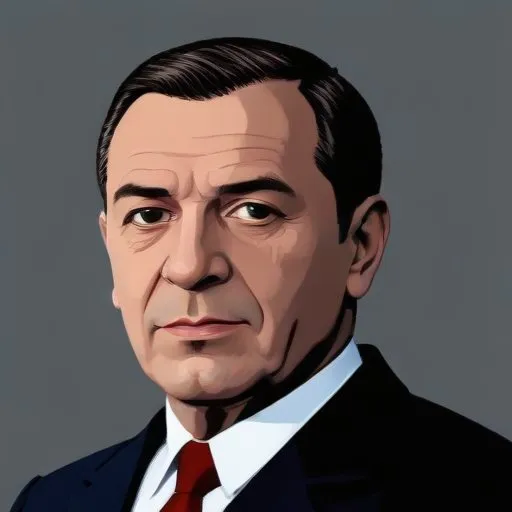
A Yugoslav politician who served as the President of the Yugoslav National Assembly and played a key role in the country's unification and post-WWII reconstruction.
Ivan Ribar, a prominent Croatian politician, is best known for his significant roles in various Yugoslavian governments, as well as his dedication to the PanSlavist and communist ideologies. Throughout his illustrious career, he fought against the Nazi occupation of Yugoslavia, playing a crucial role in the country's struggle for independence.
Born on January 21, 1881, in Vukmani, Karlovac, Ribar grew up to become a lawyer, earning a PhD in law. He worked as an attorney in Zagreb, Đakovo, and Belgrade, laying the foundation for his future political endeavors.
Ribar's personal life was marred by tragedy during World War II, as he lost his entire family. His two sons, Ivo Lola and Jurica, were killed in action in 1943 while fighting for the Partisans, and his wife, Antonija, was executed by the Germans in 1944. Despite this personal loss, Ribar continued to fight for his country's freedom.
Ribar's political career spanned several decades and numerous positions. He served as:
From 1945 to 1953, Ribar was the de jure head of state of Yugoslavia, with his position as parliamentary speaker made equivalent to that of president.
In 1952, Ribar married painter and poet Cata Dujšin-Ribar and moved into her flat on 3 Demeter Street in Zagreb. He spent his later years in Zagreb, passing away on February 2, 1968, at the age of 87. After his death, his widow donated their flat and art collection to the city of Zagreb in 1976.
Today, Ivan Ribar is remembered as a leading figure in Yugoslavian politics, a champion of communist ideology, and a hero of the country's struggle for independence during World War II.
Born in 1892
Led the Yugoslav Partisans to victory in World War II and later became a unifying figure, serving as the President of Yugoslavia from 1953 to 1980. He's known for his unique blend of communist and nationalist policies.
Born in 1910
A Slovene general, economist, and politician who played a key role in shaping Yugoslavia's post-WWII economy and foreign policy, and is known for his efforts to decentralize the Yugoslav government.
