


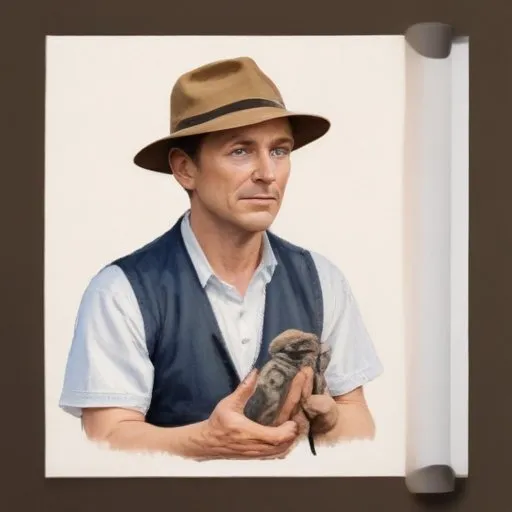
A renowned expert in bird evolution and fossils, known for discovering and describing numerous bird species and contributing significantly to the field of ornithology.
Alexander Wetmore is renowned for his groundbreaking contributions to the fields of ornithology and avian paleontology, leaving an indelible mark on our understanding of birds and their fossilized predecessors. As the sixth Secretary of the Smithsonian Institution, Wetmore's legacy extends far beyond his remarkable scientific accomplishments, shaping the very fabric of American scientific institutions and inspiring generations of researchers.
Born on June 18, 1886, in North Freedom, Wisconsin, Wetmore's fascination with birds began at an tender age. His first field journal entry, made at just eight years old, chronicled a pelican sighting during a family vacation. This nascent interest blossomed into a lifelong passion, with Wetmore publishing his first paper, "My Experience with a Redheaded Woodpecker," in BirdLore magazine by 1900.
Wetmore's academic pursuits took him to the University of Kansas, where he enrolled in 1905. During his studies, he worked as an assistant in the University Museum under the guidance of Charles D. Bunker. He earned his BA in 1912, followed by his MS in 1916 and PhD in 1920 from George Washington University.
Wetmore's entry into federal service in 1910 marked the beginning of a remarkable career, starting with the Biological Survey of the Department of Agriculture. His research on the use of lead shot in causing death in waterfowl (1915) and paleontological discoveries, including the fossil birds Palaeochenoides mioceanus and Nesotrochis debooyi, solidified his reputation as a leading expert in his field.
In 1923-1924, Wetmore led the Tanager Expedition, a series of five biological surveys to study the flora, fauna, and geology of the Northwestern Hawaiian Islands, Johnston Atoll, and Wake Island. This expedition yielded significant discoveries, further cementing Wetmore's status as a trailblazer in ornithology and avian paleontology.
In 1924, Wetmore joined the Smithsonian Institution as the superintendent of the National Zoo in Washington, D.C. His leadership abilities and scientific prowess earned him the role of assistant secretary of the Smithsonian Institution in 1925. Wetmore's tenure as secretary from 1945 to 1952 was marked by significant growth and modernization of the institution.
Alexander Wetmore's remarkable career has left an enduring impact on the scientific community. Elected as a member of both the American Philosophical Society and the United States National Academy of Sciences, Wetmore's contributions have inspired generations of ornithologists and paleontologists. His legacy extends beyond the scientific realm, shaping the Smithsonian Institution and American scientific institutions as a whole.
Alexander Wetmore's remarkable life and achievements serve as a testament to the power of dedication, passion, and scientific inquiry. His work continues to inspire new generations of researchers, ensuring that his legacy will endure for centuries to come.
Born in 1908
Renowned for creating detailed and accessible field guides, this ornithologist helped popularize birdwatching and conservation, making nature more accessible to the masses.
Born in 1785
A pioneering ornithologist and artist, famous for meticulously illustrating and documenting North American bird species in his iconic book "The Birds of America". His work remains a cornerstone of ornithology and wildlife art.
Born in 1860
A renowned outdoorsman and conservationist, he wrote influential books on wildlife and the wilderness, inspiring generations to appreciate and protect nature.
Born in 1888
A pioneering physiologist who discovered the different roles of nerve fibers in transmitting sensory information, earning him a Nobel Prize in Physiology or Medicine in 1944.
