


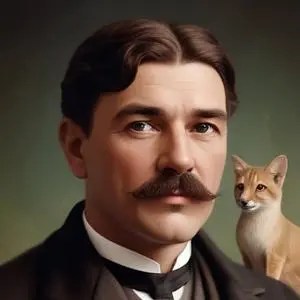
A renowned outdoorsman and conservationist, he wrote influential books on wildlife and the wilderness, inspiring generations to appreciate and protect nature.
Ernest Thompson Seton, a Canadian-American author, wildlife artist, and outdoorsman, is best known for founding the Woodcraft Indians in 1902, which later became the Woodcraft League of America, and playing a pivotal role in the formation of the Boy Scouts of America (BSA) in 1910.
Seton was born Ernest Evan Thompson on August 14, 1860, in South Shields, County Durham, England, to Scottish parents. His family emigrated to British North America in 1866, and he spent most of his childhood in Toronto, Canada. As a youth, he would often retreat to the woods of the Don River to draw and study animals, escaping his abusive father.
Seton's passion for art led him to attend the Ontario College of Art in 1879, where he studied with John Colin Forbes. He later won a scholarship to the Royal Academy in London, England, in 1880, and continued his studies at the Académie Julian in Paris in the 1890s.
In 1902, Seton founded the Woodcraft Indians, a youth organization that focused on outdoor skills, nature study, and character development. The organization's popularity led to its renaming as the Woodcraft League of America in 1910.
That same year, Seton met Lord Baden-Powell, the founder of the Scouting movement, and shared his ideas and experiences with him. Seton's work had a profound influence on Baden-Powell, who incorporated many of Seton's principles into the Scouting movement.
In 1910, Seton co-founded the Boy Scouts of America (BSA) with Robert Baden-Powell and Daniel Carter Beard. Seton's book, The Birch Bark Roll, became a seminal work in the Scouting movement, and his ideas about character development, outdoor skills, and nature study continue to shape the BSA to this day.
Seton was a prolific artist and writer, publishing numerous books and articles on wildlife, outdoor skills, and Scouting. Some of his notable works include The Birch Bark Roll, The Boy Scout Handbook, and Trail of an Artist-Naturalist: The Autobiography of Ernest Thompson Seton.
Seton's artistic talents were recognized with his election as an associate member of the Royal Canadian Academy of Arts in 1893.
Seton's relationship with his father was strained, and on his 21st birthday, his father presented him with an invoice for all of his childhood expenses. Seton never spoke to his father again after this incident.
Seton's incorporation of what he believed to be American Indian elements into the Scouting movement has been criticized for cultural appropriation. However, his contributions to the development of Scouting and outdoor education remain unparalleled.
Ernest Thompson Seton's legacy extends far beyond his contributions to the Scouting movement. He was a pioneering figure in outdoor education, and his ideas about character development, nature study, and outdoor skills continue to inspire generations of young people.
Seton's artistic and literary works remain a testament to his passion for the natural world and his commitment to sharing that passion with others.
Born in 1785
A pioneering ornithologist and artist, famous for meticulously illustrating and documenting North American bird species in his iconic book "The Birds of America". His work remains a cornerstone of ornithology and wildlife art.
Born in 1838
A pioneering conservationist and writer who advocated for the preservation of America's wilderness and national parks, inspiring generations to appreciate and protect the natural world.
Born in 1858
A pioneering leader who championed progressive reforms, trust-busting, and conservation, earning a Nobel Peace Prize for mediating the Russo-Japanese War. He's also famous for his rugged outdoorsmanship and "big stick" diplomacy.
Born in 1837
A renowned naturalist and writer who explored the American wilderness, documenting its beauty and importance in numerous essays and books. He's celebrated for his poetic descriptions of nature and advocacy for conservation.
Born in 1817
A 19th-century thinker who advocated for simple living, civil disobedience, and individualism, inspiring generations to reevaluate their relationship with nature and society.
