


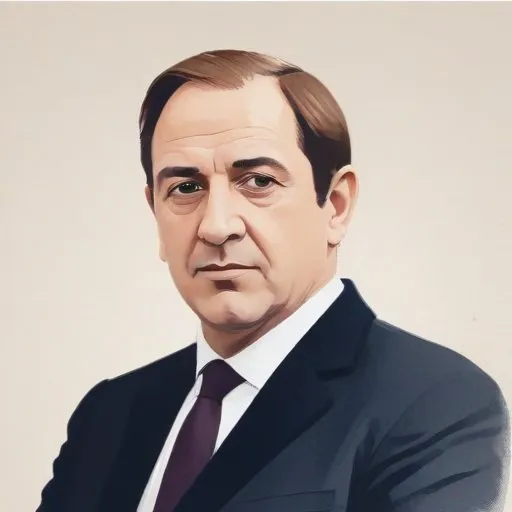
A Greek sociologist and politician who served as Prime Minister of Greece, known for his efforts to modernize and democratize the country. He introduced significant reforms, including the establishment of a republic and women's suffrage.
Alexandros Papanastasiou was a Greek lawyer, sociologist, and politician who served twice as the Prime Minister of Greece in the interwar period, pioneering the establishment of the Second Hellenic Republic. He is renowned for his efforts in agrarian reform, particularly in Thessaly, and his role in bringing Greece onto the side of the Allies during World War I.
Born on 8 July 1876 in Tripoli, Greece, Papanastasiou was the son of Panagiotis Papanastasiou, a member of Parliament, and Marigo Rogari-Apostolopoulou. He spent his early years in Kalamata and Piraeus before studying law at the National and Kapodistrian University of Athens, where he earned his doctorate in 1899 and a license in 1901.
He furthered his education in social science, law, and philosophy at the Friedrich Wilhelm University of Berlin and the University of Heidelberg from 1901 to 1905. Later, he traveled to London and Paris, continuing his studies until 1907, when he returned to Greece.
In 1910, Papanastasiou was first elected to the Hellenic Parliament, where he advocated for agrarian reform in Thessaly. He aimed to break up large farms that had existed since the Ottoman Empire and redistribute them to local farmers.
In 1916, he joined the Provisional Government of National Defence under Eleftherios Venizelos in Thessaloniki, which sought to bring Greece onto the side of the Allies during World War I. He was subsequently appointed as the governor of the Ionian Islands.
After World War I, Papanastasiou participated in several Venizelos governments, holding positions such as Minister of Transportation, Minister of National Health, and Interior Minister. When Venizelos lost the 1920 elections, Papanastasiou remained in Greece and critiqued the People's Party governments.
Alexandros Papanastasiou's contributions to Greek politics and society are undeniable. He played a crucial role in shaping the country's future, particularly in the establishment of the Second Hellenic Republic. His efforts in agrarian reform and his commitment to bringing Greece onto the side of the Allies during World War I have left a lasting legacy.
Today, Papanastasiou is remembered as a pioneer and a visionary who fought for the betterment of Greece and its people.
Alexandros Papanastasiou's life and legacy serve as a testament to his dedication to Greece and its people. His contributions to politics, sociology, and law have left an indelible mark on the country's history.
Born in 1864
A Greek statesman who played a crucial role in shaping modern Greece, leading the country through significant reforms and transformations. He's known for his visionary leadership and diplomatic prowess.
Born in 1888
A Greek lawyer, economist, and politician who served as the Prime Minister of Greece from 2009 to 2011, known for his efforts to address the country's debt crisis.
Born in 1919
Greek economist and politician who served as Prime Minister of Greece, known for his socialist policies and efforts to reduce Greece's reliance on foreign capital. He also played a key role in Greece's accession to the European Union.
Born in 1907
A Greek lawyer and politician who served as President of Greece, known for leading the country's transition from military dictatorship to democracy. He's credited with modernizing Greece and joining the European Union.
Born in 1871
A Greek general and politician who served as the 130th Prime Minister of Greece, known for his authoritarian regime and opposition to the Axis powers during World War II. He implemented a series of reforms and modernization projects, but also suppressed political opposition and civil liberties.
Born in 1868
A conservative Greek politician who served as Prime Minister of Greece during the 1930s and 1940s, known for his strong anti-communist stance and leadership during World War II.
