


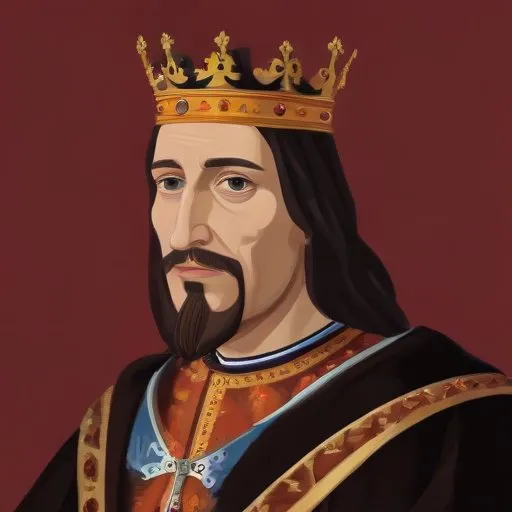
King of Castile from 1158 to 1214, known for his military campaigns, particularly the Battle of Las Navas de Tolosa, which marked a significant turning point in the Reconquista.
Alfonso VIII, known as "The Noble" or "The One of Las Navas," was a valiant king of Castile who reigned from 1158 to 1214, leaving an indelible mark on the Iberian Peninsula. He is celebrated for his triumphant victory over the Almohads in the Battle of Las Navas de Tolosa in 1212, which marked a significant turning point in the struggle between Christian and Muslim forces.
Born on November 11, 1155, in Soria, Alfonso VIII was the son of Sancho III of Castile and Blanche. His early life was marked by regency and civil war, as his father's death in 1158 sparked a power struggle among the nobles. Despite being proclaimed king at the tender age of two, Alfonso was largely nominal, with various noble houses vying for control.
Alfonso's early years were marked by instability, with the noble houses of Lara and Castro, as well as his uncle, Ferdinand II of León, claiming the regency. The young king was briefly placed in the custody of Garćía Garcés de Aza, who was unable to provide for him. The Castro and Lara factions clashed in the Battle of Lobregal in 1159, resulting in the Castro emerging victorious, but ultimately, the guardianship of Alfonso fell to Manrique Pérez.
Alfonso VIII's reign was characterized by a series of military campaigns aimed at expanding his kingdom and asserting Christian dominance over the Iberian Peninsula. In 1195, he suffered a crushing defeat at the hands of the Almohads at the Battle of Alarcos, but rebounded in 1212 with a decisive victory at the Battle of Las Navas de Tolosa.
This pivotal battle marked a significant shift in the balance of power, as Alfonso VIII led a coalition of Christian princes and foreign crusaders to defeat the Almohads. The victory paved the way for Christian supremacy in the region and cemented Alfonso's reputation as a brave and cunning military leader.
Alfonso VIII's reign was also marked by a series of diplomatic alliances and marriages that strengthened his position and secured his legacy. His alliance with Aragon, for example, drew the two spheres of Christian Iberia into close connection, while his marriage to Eleanor of England solidified ties with the English monarchy.
Alfonso VIII's reign had a profound impact on the course of Spanish history, as he played a crucial role in shaping the country's medieval landscape. His military campaigns, diplomatic alliances, and strategic marriages helped establish Castile as a dominant force in the region, paving the way for the eventual reunification of the kingdoms under his grandson, Ferdinand III of Castile.
Alfonso VIII's remarkable life and reign serve as a testament to his bravery, cunning, and strategic vision, earning him a revered place in the annals of Spanish history.
Born in 1380
Unified the Crown of Aragon, ruling over a vast territory in eastern Spain, and sponsored the voyages of Christopher Columbus, leading to the discovery of the New World.
Born in 1451
Unified the Spanish kingdoms, sponsored Christopher Columbus's voyage to the Americas, and established the Spanish Inquisition.
Born in 1405
King of Castile from 1406 to 1454, known for his struggles to maintain power and stability in a tumultuous kingdom, marked by conflicts with nobles and the rise of the Catholic Monarchs.
