


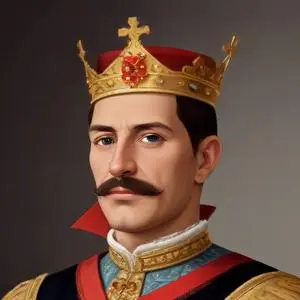
Ferdinand II, also known as Ferdinand the Catholic, is renowned for his pivotal role in uniting Spain through his marriage to Isabella I of Castile, thereby earning the moniker "the Catholic Monarchs." Together, they sponsored Christopher Columbus's voyage to the Americas in 1492, marking a significant milestone in European colonization.
Born on March 10, 1452, in Sos del Rey Católico, Kingdom of Aragon, Ferdinand was the son of John II of Aragon. He inherited the Crown of Aragon in 1479, which comprised the kingdoms of Aragon, Valencia, Majorca, Sardinia, and Sicily, as well as the Principality of Catalonia.
Ferdinand's marriage to Isabella I of Castile in 1469 formed the basis of a unified Spain. The couple's joint reign brought about the end of the centuries-long Reconquista, culminating in the defeat of Granada, the last Muslim state in Western Europe, in 1492. This union also led to the sponsorship of Christopher Columbus's first voyage, which marked the beginning of European colonization of the Americas.
Ferdinand's military campaigns led to the conquest of the Kingdom of Naples in 1504 and the Kingdom of Navarre in 1512. He also annexed parts of France through the Treaty of Blois in 1505. His territorial expansions paved the way for a unified and powerful Spanish monarchy.
Ferdinand II's legacy extends beyond his military conquests. He and Isabella established the Spanish Inquisition, which aimed to maintain Catholic orthodoxy in Spain. He also supported the establishment of the University of Alcalá de Henares, which became a hub for humanist learning. Ferdinand's reign laid the foundation for Spain's emergence as a dominant world power in the 16th century.
Ferdinand married Germaine of Foix in 1506, following Isabella's death in 1504. He became regent of Castile on behalf of his daughter Joanna, who was deemed mentally unfit to rule. Upon his death in 1516, Ferdinand was succeeded by his daughter Joanna, but real power was soon assumed by her son, Charles I (later Holy Roman Emperor Charles V).
Ferdinand II's enduring legacy as the unifier of Spain and his role in shaping the country's history make him an fascinating figure in the annals of European history.
Born in 1451
Unified the Spanish kingdoms, sponsored Christopher Columbus's voyage to the Americas, and established the Spanish Inquisition.
Born in 1405
King of Castile from 1406 to 1454, known for his struggles to maintain power and stability in a tumultuous kingdom, marked by conflicts with nobles and the rise of the Catholic Monarchs.
Born in 1748
The last king of the Spanish Habsburg dynasty, he's known for his ineptitude and weakness, which led to the downfall of the Spanish Empire and the rise of the Bourbon dynasty. He's also infamous for his numerous scandals and corrupt court.
Born in 1380
Unified the Crown of Aragon, ruling over a vast territory in eastern Spain, and sponsored the voyages of Christopher Columbus, leading to the discovery of the New World.
Born in 1710
The monarch who ruled France from 1715 to 1774, known as the "Sun King's" great-grandson, and remembered for his extravagance, absolutism, and the decline of the French monarchy.
