


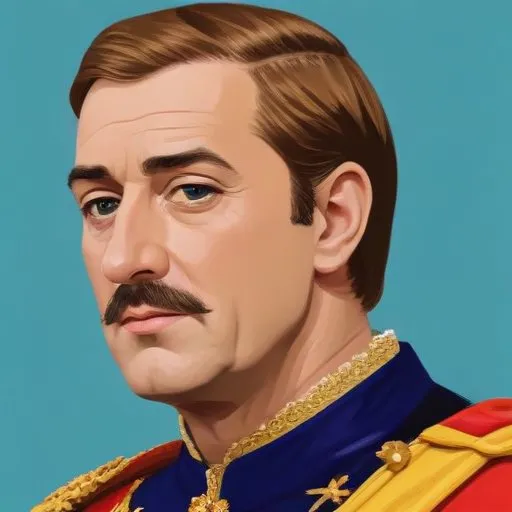
The last king of the Spanish Habsburg dynasty, he's known for his ineptitude and weakness, which led to the downfall of the Spanish Empire and the rise of the Bourbon dynasty. He's also infamous for his numerous scandals and corrupt court.
Charles IV of Spain, also known as Carlos Antonio Pascual Francisco Javier Juan Nepomuceno Jos Januario Serafn Diego de Borbn y Sajonia, was the King of Spain and ruler of the Spanish Empire from 1788 to 1808. He is notoriously remembered for his series of disadvantageous alliances, corrupt regime, and eventual abdication, marking a significant turning point in Spanish history.
Born on November 11, 1748, in Naples, Charles was the second son of Charles III and Maria Amalia of Saxony. Due to his elder brother's learning disabilities and epilepsy, Charles was next in line to the thrones of Spain, Naples, and Sicily. Nicknamed "El Cazador" (the Hunter) for his passion for sport and hunting, Charles was more interested in leisure activities than governing the state.
Charles IV succeeded his father, Charles III, in 1788 and ruled for nearly two decades. Despite his professed belief in the sanctity of the monarchy, his reign was marred by corruption, nepotism, and cronyism. He detested his son and heir, Ferdinand, who conspired against him in the El Escorial Conspiracy and eventually forced his abdication after the Tumult of Aranjuez in 1808.
During his reign, Charles IV's regime was plagued by financial mismanagement, with Spain entering into a series of costly wars and accumulating massive debts. His reliance on his widely hated first minister, Manuel de Godoy, further exacerbated the situation, leading to widespread discontent and unrest.
In 1808, Charles IV was summoned to Bayonne by Napoleon Bonaparte, who orchestrated the abdication of both Charles IV and his son, Ferdinand VII, paving the way for Napoleon's brother, Joseph Bonaparte, to assume the Spanish throne.
The reign of Charles IV was a significant turning point in Spanish history, marking the beginning of the country's decline as a major power. Historian Stanley G. Payne has described Charles IV as "goodhearted but weak and simpleminded," whose ineptitude and corruption led to Spain's downfall.
Despite his controversial legacy, Charles IV did found the Royal University of Guadalajara in 1791, which exists to this day as the University of Guadalajara. This institution has played a significant role in promoting education and intellectual pursuits in Mexico.
Charles IV was married to Maria Luisa of Parma, with whom he had 14 children. He was known for his love of hunting and was often referred to as "El Cazador."
Charles IV's tumultuous reign and eventual abdication have left a lasting impact on Spanish history, serving as a cautionary tale about the dangers of corruption, nepotism, and ineptitude in governance.
Born in 1713
King of Spain from 1746 to 1759, known for his cultural and economic reforms, and for being the first Spanish monarch to visit Catalonia in over a century.
Born in 1830
Queen of Spain from 1833 to 1868, known for her tumultuous reign marked by political instability, corruption, and social unrest. She was eventually exiled to France after a revolution.
Born in 1716
The Enlightened Despot who reformed Spain, promoting education, arts, and economic growth, and is credited with modernizing Madrid.
Born in 1707
King of Spain from 1724 to 1724, known for his brief and tumultuous reign that ended with his abdication. He's a footnote in Spanish history.
