


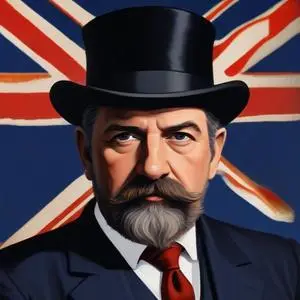
The 2nd Prime Minister of Australia, a key figure in the country's early development, known for his role in shaping Australia's constitution and federation. He played a crucial part in uniting the country's six colonies into a single nation.
Known as the second Prime Minister of Australia, Alfred Deakin was a pioneering statesman, politician, and barrister who played a pivotal role in shaping the nation's early years. He is celebrated for his instrumental contributions to the Federation of Australia, serving as Prime Minister from 1903 to 1904, 1905 to 1908, and 1909 to 1910.
Born on August 3, 1856, in Melbourne, Deakin rose to prominence through his dedication to public service, journalism, and the law. He was elected to the Victorian Legislative Assembly in 1879, at just 23 years old, and went on to hold ministerial office intermittently from 1883. Deakin's commitment to liberal and radical reform earned him a reputation as a champion of social and political change.
In the 1890s, Deakin became a driving force behind the movement for Australian Federation. He attended federal conventions, served on committees that drafted the federal constitution, and campaigned tirelessly for its adoption through a series of referendums. His efforts ultimately led to the Federation of Australia in 1901.
Deakin's tenure as Prime Minister was marked by periods of instability and power struggles. He formed governments, lost power, and regained it, often relying on delicate alliances with other parties. His controversial decision to merge his Liberal Protectionist Party with the Free Traders in 1909, known as the Fusion, marked a significant shift in Australian politics and paved the way for a two-party system.
Deakin's personal life was often overshadowed by his demanding political career. Despite this, he maintained a strong connection with his family and was deeply committed to his wife, Pattie. The couple had three daughters together and were known for their strong bond.
Deakin's political ideology was rooted in his commitment to liberalism, protectionism, and social reform. He believed in the importance of fostering Australian industry and protecting local interests, while also advocating for progressive social policies.
Deakin's legacy extends far beyond his time in office. His role in shaping Australia's early years has had a lasting impact on the nation's development, politics, and society. His contributions to the Federation movement, his commitment to social reform, and his influence on the development of a two-party system continue to shape Australian politics today.
"The nation will find its salvation, not in militarism, not in imperialism, not in the despotism of the few, but in the extension of democracy, in the development of the intellectual and moral life of the masses."
This powerful quote, spoken during Deakin's 1909 campaign, reflects his enduring commitment to democracy, social reform, and the betterment of Australian society.
Deakin's turbulent political career, marked by periods of triumph and defeat, has left an indelible mark on Australian history. His legacy serves as a testament to the power of dedication, perseverance, and vision in shaping a nation's course.
Today, Deakin's impact is felt across Australia, from the country's robust democracy to its thriving economy. His story serves as an inspiration to generations, a reminder that even the most ambitious dreams can become a reality with determination and hard work.
Born in 1862
The 5th Prime Minister of Australia, a key figure in the country's early 20th-century politics, known for his role in shaping Australia's social and economic landscape. He played a crucial part in establishing the country's old-age pension and maternity allowance systems.
Born in 1867
Third Prime Minister of Australia, serving from 1904 to 1905, known for his efforts to establish a national government and implement progressive reforms.
Born in 1845
The 4th Prime Minister of Australia, a Scottish-Australian lawyer and politician who served from 1904 to 1905, known for his role in shaping the country's early years and contributing to its growth.
64 Years Old
The first female Prime Minister of Australia, serving from 2010 to 2013, known for her progressive policies and leadership during a period of significant economic reform.
68 Years Old
The 28th Prime Minister of Australia, a conservative leader who served from 2013 to 2015, known for his tough stance on immigration and climate change skepticism. He's also a Rhodes Scholar and athlete.
71 Years Old
Australian journalist and politician who served as the 29th Prime Minister of Australia, known for his leadership during a tumultuous period in Australian politics and his advocacy for progressive policies.
68 Years Old
The 26th Prime Minister of Australia, a diplomat, and leader who apologized to the Indigenous Australians for past injustices and played a key role in shaping the country's climate change policies.
Born in 1885
Led the country through World War II, implementing policies to defend Australia and its economy. He's also known for his leadership during the country's transition from British to American influence.
