


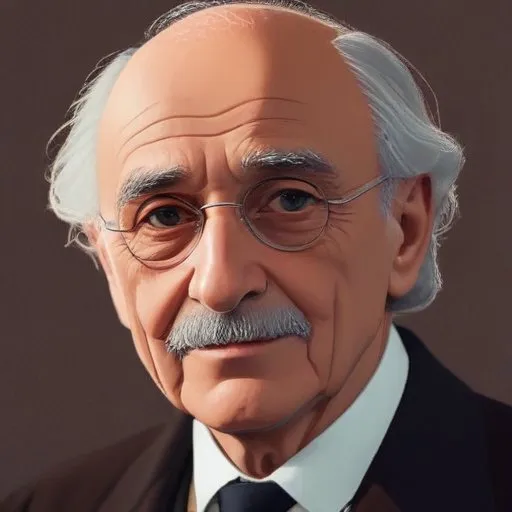
A German-French physicist and poet who discovered the method of optical pumping, a technique used to prepare atoms for laser action, and was awarded the Nobel Prize in Physics in 1966.
Alfred Kastler, a French physicist, is renowned for his groundbreaking work on the development of optical pumping, a technique that revolutionized the field of spectroscopy and paved the way for the creation of lasers and masers. This Nobel Prize laureate's contributions to the understanding of light-atom interactions have had a profound impact on modern physics.
Born on May 3, 1902, in Guebwiller, Alsace, German Empire, Kastler grew up in a region that would later become part of France. He attended the Lyce Bartholdi in Colmar and later enrolled in the École Normale Supérieure in Paris in 1921, laying the foundation for his future success.
Kastler's academic career spanned several decades and institutions. He began teaching physics at the Lyce of Mulhouse in 1926 and later moved to the University of Bordeaux, where he became a university professor until 1941. It was during this period that he collaborated with Georges Bruhat, which led to his return to the École Normale Supérieure in 1952, where he secured a chair.
In the 1950s, Kastler, in collaboration with Jean Brossel, conducted extensive research on quantum mechanics, the interaction between light and atoms, and spectroscopy. Their work led to the development of optical pumping, a technique that enables the selective excitation of atoms and molecules using light. This breakthrough laid the foundation for the creation of lasers and masers, earning Kastler the Nobel Prize in Physics in 1966.
Kastler was not only a devoted scientist but also a dedicated philanthropist. He served as the first chairman of the non-governmental organization Action Against Hunger, demonstrating his commitment to improving the human condition.
In addition to his scientific pursuits, Kastler was a poet who wrote in German. His poetry collection, "Europe, ma patrie" (Europe, my fatherland), was published in 1971. The Laboratoire Kastler-Brossel, a research institution, was established in his honor, a testament to his enduring legacy.
Kastler's work has left an indelible mark on the world of physics, paving the way for future generations of scientists to explore the mysteries of light and matter. His contributions continue to inspire and influence the scientific community, ensuring his legacy as a pioneering physicist.
80 Years Old
A former NHL player and coach who later became a popular French-language hockey broadcaster, known for his charismatic commentary and expert analysis.
Born in 1859
A pioneer in radioactivity research, discovering elements like polonium and radium, and pioneering radioactive isolation techniques. Their groundbreaking work paved the way for advancements in medicine, energy, and materials science.
Born in 1867
A pioneering scientist who pioneered radioactivity research, discovering elements polonium and radium, and paving the way for breakthroughs in medicine and energy.
Born in 1892
A French physicist and Nobel laureate who proposed that particles, such as electrons, can exhibit wave-like behavior, revolutionizing quantum mechanics. His hypothesis led to major breakthroughs in understanding the atomic structure.
