


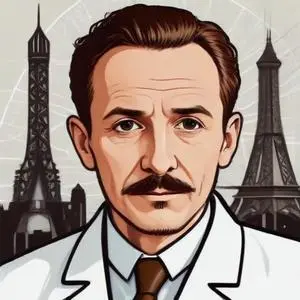
A pioneer in radioactivity research, discovering elements like polonium and radium, and pioneering radioactive isolation techniques. Their groundbreaking work paved the way for advancements in medicine, energy, and materials science.
Pierre Curie, a French physicist, is renowned for his groundbreaking work in crystallography, magnetism, piezoelectricity, and radioactivity, earning him the Nobel Prize in Physics in 1903 alongside his wife Marie Curie and Henri Becquerel. This recognition cemented the Curies as the first married couple to win the prestigious award, marking the beginning of a legacy that would go on to garner a total of five Nobel Prizes.
Born on May 15, 1859, in Paris, Pierre Curie was the son of Eugène Curie, a doctor of French Huguenot Protestant origin from Alsace, and Sophie-Claire Curie née Depouilly. From a young age, Pierre demonstrated a keen aptitude for mathematics and geometry, earning his Bachelor of Science degree in mathematics at just 16 years old.
By 18, he had obtained his license, equivalent to a U.S. master's degree, in physical sciences from the Faculty of Sciences at the Sorbonne, also known as the University of Paris. Financial constraints, however, prevented him from pursuing a doctorate immediately, leading him to work as a laboratory instructor.
In 1880, Pierre, along with his older brother Paul-Jacques, made a significant breakthrough, demonstrating that an electric potential was generated when crystals were compressed – a phenomenon known as piezoelectricity. This discovery led to the invention of the piezoelectric quartz electrometer, a device that would aid their research.
The following year, the brothers further demonstrated the direct piezoelectric effect, a discovery that would have far-reaching implications for the fields of physics and chemistry.
Pierre Curie's work laid the foundation for future breakthroughs in radioactivity, paving the way for advancements in medicine, industry, and scientific research. His legacy extends beyond his scientific contributions, inspiring generations of scientists, particularly women, to pursue careers in physics and chemistry.
The Curies' groundbreaking work on radioactivity also led to the development of new medical treatments, including the use of radiation therapy for cancer treatment.
Pierre Curie's life was cut short in a tragic accident on April 19, 1906, when he was struck by a horse-drawn carriage in the streets of Paris. His untimely death at the age of 46 was a devastating blow to the scientific community and his family.
Pierre Curie's contributions to science, his legacy, and his untimely death have cemented his place as one of the most influential scientists of the early 20th century. His work continues to inspire and influence researchers, policymakers, and the general public, solidifying his position as a pioneer in the fields of physics, chemistry, and beyond.
Born in 1867
A pioneering scientist who pioneered radioactivity research, discovering elements polonium and radium, and paving the way for breakthroughs in medicine and energy.
Born in 1852
Discovered radioactivity, a fundamental property of atoms, and pioneered research in the field, leading to breakthroughs in medicine, energy, and materials science.
Born in 1871
A pioneer in nuclear physics, he discovered the nucleus of an atom and developed the Rutherford model, revolutionizing our understanding of the atomic structure.
Born in 1856
A pioneering engineer who harnessed the power of alternating current (AC) to transform the world's electrical systems, and is credited with developing groundbreaking technologies like radio communication and X-ray imaging.
Born in 1879
A brilliant physicist who developed the theory of relativity and is considered one of the most influential scientists of the 20th century, known for his groundbreaking work in physics and mathematics.
Born in 1858
A pioneer in quantum theory, he introduced the concept of the Planck constant, revolutionizing our understanding of energy and matter.
Born in 1885
A pioneer in quantum mechanics, he introduced the concept of wave-particle duality, revolutionizing our understanding of atomic structure. His philosophical approach to science also explored the nature of reality and human understanding.
