


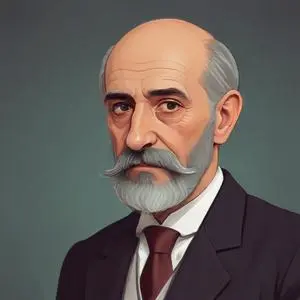
Discovered radioactivity, a fundamental property of atoms, and pioneered research in the field, leading to breakthroughs in medicine, energy, and materials science.
Henri Becquerel, a French physicist, engineer, and Nobel laureate, is renowned for his groundbreaking discovery of radioactivity, a phenomenon that revolutionized our understanding of the atomic world. Alongside Marie and Pierre Curie, Becquerel received the 1903 Nobel Prize in Physics for his pioneering work in this field.
Born on December 15, 1852, in Paris, France, Henri Becquerel came from a distinguished family of physicists. His grandfather, Antoine César Becquerel, was a prominent physicist, and his father, Alexandre Edmond Becquerel, was a renowned physicist and inventor. This legacy of scientific excellence paved the way for Henri's future accomplishments.
Becquerel began his education at the Lycée Louis-le-Grand school in Paris, followed by engineering studies at the École Polytechnique and the École des Ponts et Chaussées. This strong foundation in science and engineering laid the groundwork for his future research in physics.
Early in his career, Becquerel became the third member of his family to hold the physics chair at the Muséum National d'Histoire Naturelle in 1892. He later became the chief engineer in the Department of Bridges and Highways before delving into his early experiments. Becquerel's investigations focused on plane polarization of light, phosphorescence, and the absorption of light by crystals.
In 1895, he was appointed professor at the École Polytechnique, where he continued to explore the mysteries of light and its interactions. This line of inquiry ultimately led to his serendipitous discovery of spontaneous radioactivity in 1896.
While studying the properties of uranium salts, Becquerel discovered that they emitted a previously unknown type of radiation, which he called "uranic rays." This breakthrough led to a deeper understanding of the atomic structure and paved the way for future discoveries in nuclear physics.
Becquerel's groundbreaking work earned him the 1903 Nobel Prize in Physics, shared with Marie and Pierre Curie. The SI unit of radioactivity, the becquerel (Bq), was later named in his honor.
Becquerel's discovery of radioactivity has had a profound impact on modern society, influencing fields such as medicine, energy, and materials science. His work has inspired future generations of physicists, cementing his place as a pioneer in the history of physics.
Becquerel married and had a son, Jean Becquerel, who followed in his footsteps as a physicist. Despite his many accomplishments, Becquerel remained humble and dedicated to his work, leaving behind a legacy that continues to inspire and fascinate scientists and scholars alike.
Becquerel's remarkable life and achievements serve as a testament to the power of human curiosity and the importance of scientific inquiry. His discovery of radioactivity has forever changed our understanding of the atomic world, and his legacy continues to inspire new generations of scientists and thinkers.
Born in 1867
A pioneering scientist who pioneered radioactivity research, discovering elements polonium and radium, and paving the way for breakthroughs in medicine and energy.
Born in 1859
A pioneer in radioactivity research, discovering elements like polonium and radium, and pioneering radioactive isolation techniques. Their groundbreaking work paved the way for advancements in medicine, energy, and materials science.
Born in 1856
A pioneering engineer who harnessed the power of alternating current (AC) to transform the world's electrical systems, and is credited with developing groundbreaking technologies like radio communication and X-ray imaging.
Born in 1879
A brilliant physicist who developed the theory of relativity and is considered one of the most influential scientists of the 20th century, known for his groundbreaking work in physics and mathematics.
Born in 1858
A pioneer in quantum theory, he introduced the concept of the Planck constant, revolutionizing our understanding of energy and matter.
Born in 1871
A pioneer in nuclear physics, he discovered the nucleus of an atom and developed the Rutherford model, revolutionizing our understanding of the atomic structure.
Born in 1885
A pioneer in quantum mechanics, he introduced the concept of wave-particle duality, revolutionizing our understanding of atomic structure. His philosophical approach to science also explored the nature of reality and human understanding.
