


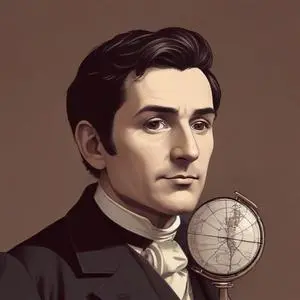
Discovered the phenomenon of radioactivity, pioneering the field of nuclear physics and earning a Nobel Prize in 1903.
Antoine César Becquerel, a French scientist, is renowned for his groundbreaking contributions to the study of electric and luminescent phenomena, earning him a prominent place in the annals of scientific history. Specifically, he is credited with the discovery of the photovoltaic effect, a breakthrough that would later pave the way for the development of solar cells.
Born on March 7, 1788, in Châtillon-sur-Loing (now Châtillon-Coligny), Becquerel's fascination with science was evident from an early age. After passing through the prestigious École Polytechnique, he became an engineer-officer in 1808 and saw active service with the imperial troops in Spain and France. Following his military stint, he devoted himself to scientific investigation, marking the beginning of his illustrious career.
In 1820, Becquerel made a significant discovery, demonstrating that pressure can induce electricity in every material, attributed to surface interactions. This finding laid the foundation for his subsequent work in electrochemistry. His inventions include the differential galvanometer (1825) for accurate measurement of electrical resistance and the constant-current electrochemical cell (1829), a precursor to the Daniell cell.
In 1839, in collaboration with his son, A. E. Becquerel, Antoine discovered the photovoltaic effect on an electrode immersed in a conductive liquid. This breakthrough would later have a profound impact on the development of solar energy.
Becquerel's earliest work was mineralogical in nature, focusing on the study of electricity and electrochemistry. His research led to the preparation of metallic elements from their ores through electrolysis, a process that would later find applications in various industries.
In 1837, Becquerel was elected a Fellow of the Royal Society and received the prestigious Copley Medal for his contributions to the field of electricity. His work was widely recognized, and he became a prominent figure in the scientific community.
Antoine César Becquerel's pioneering work in electricity and electrochemistry has had a lasting impact on modern science. His discoveries and inventions have paved the way for significant advancements in fields such as solar energy, materials science, and electrochemistry. Today, he is remembered as a true visionary, whose contributions continue to inspire and influence scientists across the globe.
Becquerel's personal life was marked by significant milestones, including his service in the French army and his subsequent devotion to scientific investigation. His collaborations with his son, A. E. Becquerel, demonstrated the importance of family and mentorship in the pursuit of scientific discovery.
Through his tireless pursuit of scientific knowledge, Antoine César Becquerel has left an indelible mark on the world of physics and chemistry. His groundbreaking contributions continue to inspire and influence scientists, ensuring his legacy as a true pioneer in the history of science.
Born in 1852
Discovered radioactivity, a fundamental property of atoms, and pioneered research in the field, leading to breakthroughs in medicine, energy, and materials science.
Born in 1867
A pioneering scientist who pioneered radioactivity research, discovering elements polonium and radium, and paving the way for breakthroughs in medicine and energy.
Born in 1859
A pioneer in radioactivity research, discovering elements like polonium and radium, and pioneering radioactive isolation techniques. Their groundbreaking work paved the way for advancements in medicine, energy, and materials science.
Born in 1871
A pioneer in nuclear physics, he discovered the nucleus of an atom and developed the Rutherford model, revolutionizing our understanding of the atomic structure.
Born in 1885
A pioneer in quantum mechanics, he introduced the concept of wave-particle duality, revolutionizing our understanding of atomic structure. His philosophical approach to science also explored the nature of reality and human understanding.
Born in 1879
A brilliant physicist who developed the theory of relativity and is considered one of the most influential scientists of the 20th century, known for his groundbreaking work in physics and mathematics.
Born in 1858
A pioneer in quantum theory, he introduced the concept of the Planck constant, revolutionizing our understanding of energy and matter.
Born in 1822
Developed vaccines for rabies and anthrax, and pioneered the germ theory of disease, revolutionizing our understanding of microbiology and disease prevention.
