


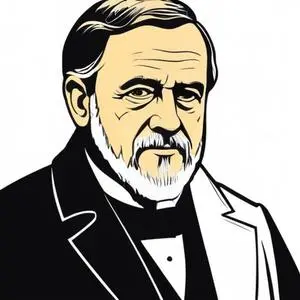
Developed vaccines for rabies and anthrax, and pioneered the germ theory of disease, revolutionizing our understanding of microbiology and disease prevention.
Louis Pasteur, a renowned French chemist, pharmacist, and microbiologist, is credited with revolutionizing the field of medicine through his groundbreaking discoveries in vaccination, microbial fermentation, and pasteurization. His pioneering work has saved millions of lives and laid the foundation for modern medicine, earning him the titles "Father of Bacteriology" and "Father of Microbiology."
Born on December 27, 1822, in Dole, France, Pasteur was the third child of a tanner. His early education took place in local schools, after which he attended the École Normale Supérieure in Paris. It was during his college years that he developed a passion for chemistry, ultimately leading to his focus on microbiology.
Pasteur's most significant contribution was his work on the germ theory of disease. Through a series of experiments, he demonstrated that diseases are caused by the presence of microorganisms, which can be prevented by killing or stopping the growth of these germs. This theory, though initially met with skepticism, has become a cornerstone of modern medicine.
Pasteur's work on pasteurization, a process that involves heating liquids to kill bacteria, has had a profound impact on the food industry. His development of vaccines for rabies and anthrax has saved countless lives and paved the way for modern vaccination practices.
In 1862, under the auspices of the French Academy of Sciences, Pasteur conducted an experiment that disproved the doctrine of spontaneous generation. This experiment, which involved sterilized and sealed flasks, showed that microorganisms cannot spontaneously generate, earning him the Alhumbert Prize.
Pasteur's work was not only groundbreaking from a scientific perspective but also reflected his deep-seated philosophical beliefs. He was a firm believer in the power of human reason and the importance of empirical evidence in scientific inquiry.
Pasteur's work has had a lasting impact on modern society, influencing fields beyond medicine, such as agriculture, food production, and education. His legacy continues to inspire scientists, researchers, and healthcare professionals worldwide.
"Chance favors the prepared mind." - Louis Pasteur
Pasteur's work took place during a time of significant scientific and cultural transformation. His legacy continues to shape the course of modern medicine, and his influence extends beyond the scientific community, inspiring generations of researchers and thinkers.
Pasteur's work was often compared to that of Robert Koch, another prominent microbiologist of the time. While both scientists made significant contributions to the field, their approaches and methods differed, with Pasteur focusing on the broader implications of microbiology on public health.
Louis Pasteur's remarkable life and work have left an indelible mark on the scientific community, inspiring generations to come. His pioneering spirit, passion for discovery, and commitment to improving human health continue to inspire and motivate researchers, scientists, and healthcare professionals worldwide.
Born in 1867
A pioneering scientist who pioneered radioactivity research, discovering elements polonium and radium, and paving the way for breakthroughs in medicine and energy.
Born in 1859
A pioneer in radioactivity research, discovering elements like polonium and radium, and pioneering radioactive isolation techniques. Their groundbreaking work paved the way for advancements in medicine, energy, and materials science.
Born in 1743
Father of modern chemistry, discovered oxygen, and developed a systematic method of chemical nomenclature. He laid the foundation for modern chemistry and paved the way for future scientific discoveries.
Born in 1744
A French soldier, biologist, and academic who developed a theory of inheritance of acquired characteristics, proposing that organisms adapt to their environment and pass on those traits to their offspring.
Born in 1809
Developed the theory of evolution through natural selection, revolutionizing our understanding of life on Earth. This groundbreaking idea transformed the fields of biology, ecology, and beyond.
Born in 1822
An Austrian monk who pioneered genetics by experimenting with pea plants, discovering the fundamental laws of heredity, and laying the foundation for modern genetics.
Born in 1821
A pioneer in modern medicine, he founded the field of social medicine, emphasizing the importance of social and environmental factors on health, and made significant contributions to cellular pathology.
Born in 1843
A pioneering microbiologist and physician who discovered the bacteria that cause tuberculosis, cholera, and anthrax, revolutionizing the field of microbiology and saving countless lives.
