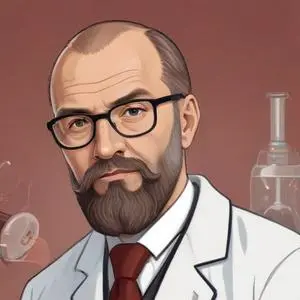
Robert Koch: The Father of Microbiology
A Pioneer in the Fight Against Infectious Diseases
Robert Koch, a German physician and microbiologist, is renowned for his groundbreaking discoveries that revolutionized our understanding of infectious diseases. As the discoverer of the specific causative agents of deadly diseases such as tuberculosis, cholera, and anthrax, Koch is regarded as one of the main founders of modern bacteriology, earning him the nickname "the father of microbiology" alongside Louis Pasteur.
Early Life and Education
Born on December 11, 1843, in Clausthal, Germany, Koch was the third of thirteen children. He studied medicine at the University of Göttingen, where he earned his doctorate in 1866. Following his studies, Koch worked as a private physician before joining the German army as a surgeon during the Franco-Prussian War.
Breakthrough Discoveries
Koch's most significant contribution to the field of microbiology was his discovery of the anthrax bacterium, Bacillus anthracis, in 1876. This discovery is considered the birth of modern bacteriology, as it provided direct proof of the germ theory of disease. Koch's work led to the development of the scientific basis of public health, ultimately saving millions of lives.
Koch's Innovations in Microbiology
- He was the first to use the oil immersion lens, condenser, and microphotography in microscopy.
- He invented the bacterial culture method using agar and glass plates, later developed as the Petri dish by his assistant Julius Richard Petri.
- He established the concept of Koch's postulates, four generalized medical principles to ascertain the relationship of pathogens with specific diseases.
Rise to Prominence
In recognition of his work, Koch was appointed as a government advisor at the Imperial Health Office in 1880. He was later promoted to a senior executive position (Geheimer Regierungsrat) in 1882 and became the Director of the Hygienic Institute and Chair Professor of Hygiene at the Faculty of Medicine, Berlin University in 1885. In 1891, he became the director of the Royal Prussian Institute for Infectious Diseases, which was later renamed the Robert Koch Institute after his death.
Honors and Legacy
Robert Koch received numerous awards and honors for his contributions to microbiology and public health. Some notable awards include the Copley Medal in 1900 and the Nobel Prize in Physiology or Medicine in 1905. Koch's legacy extends beyond his scientific contributions, as he played a crucial role in shaping modern medicine and public health policies. His work continues to inspire new generations of scientists and researchers.
Personal Life and Death
Koch married Emmy Fraatz in 1867, and they had one daughter together. He passed away on May 27, 1910, at the age of 66, leaving behind a profound impact on the world of microbiology and public health.
"One day we will have a science that will understand the interplay of the human being with the world around him."
— Robert Koch
In conclusion, Robert Koch's groundbreaking discoveries and pioneering work in microbiology have left an indelible mark on the world of science and medicine. His legacy continues to inspire and shape the way we approach public health, making him one of the most significant figures in the history of medicine.
FAQ
What were Robert Kochs contributions to microbiology?
Robert Koch made groundbreaking contributions to microbiology, including the development of Kochs postulates, which remain a fundamental principle in the field.
How did Robert Kochs discovery of the tuberculosis bacterium impact medicine?
Robert Kochs discovery of the tuberculosis bacterium led to a fundamental shift in the understanding and treatment of the disease, ultimately saving countless lives and revolutionizing public health policy.
What was Robert Kochs role in the development of vaccines?
Robert Kochs work on the tuberculosis bacterium laid the foundation for the development of vaccines against the disease, which has had a profound impact on global health.
How did Robert Kochs research impact our understanding of infectious diseases?
Robert Kochs research fundamentally changed our understanding of infectious diseases, demonstrating the role of microorganisms in causing disease and establishing the importance of germ theory in medicine.
What was Robert Kochs legacy in the field of medicine?
Robert Kochs legacy in the field of medicine is that of a pioneering scientist who has saved countless lives through his discoveries and has inspired generations of researchers and medical professionals.