


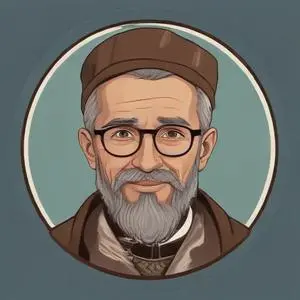
Pioneering microbiologist and ecologist who discovered chemosynthesis, the process by which microorganisms thrive in extreme environments, and founded modern soil science. His work transformed our understanding of microbial life and ecosystems.
Sergei Winogradsky, a Ukrainian and Russian microbiologist, is renowned for his groundbreaking discovery of lithotrophy, a metabolic process where microorganisms utilize inorganic compounds as an energy source. His pioneering research on Beggiatoa in 1887 shed light on the first known form of lithotrophy, where these bacteria oxidize hydrogen sulfide (H2S) to produce energy and form intracellular sulfur droplets.
Born on September 13, 1856, in Kyiv, Russian Empire (now Ukraine), Winogradsky came from a family of wealthy lawyers. His paternal ancestors included Cossack atamans, while his maternal side was connected to the Skoropadsky family.
After completing his secondary education at the 2nd Kiev Gymnasium in 1873, Winogradsky initially pursued law but soon shifted his focus to music, enrolling in the Imperial Conservatoire of Music in Saint Petersburg in 1875. However, he eventually abandoned music to study chemistry and botany at the Saint Petersburg Imperial University, graduating in 1881 and earning his master's degree in botany in 1884.
Winogradsky's research career took off under the guidance of renowned botanist Anton de Bary at the University of Strasbourg in 1885. He made significant contributions to the field of microbiology, including:
Winogradsky's remarkable contributions to microbiology earned him widespread recognition. He was awarded the:
Winogradsky's pioneering work has had a lasting impact on modern microbiology, ecology, and soil science. His research on lithotrophy and chemoautotrophy has far-reaching implications for our understanding of the natural world and the human environment.
Today, Winogradsky is celebrated as a national hero in Ukraine, where his legacy continues to inspire future generations of scientists and researchers.
In his personal life, Winogradsky underwent a transformation from being strictly devoted to the Orthodox faith in his youth to becoming irreligious later in life. He passed away on February 24, 1953, in Brie-Comte-Robert, France, leaving behind a rich legacy in the world of microbiology.
Born in 1822
Developed vaccines for rabies and anthrax, and pioneered the germ theory of disease, revolutionizing our understanding of microbiology and disease prevention.
Born in 1632
Pioneering microbiologist who discovered microorganisms like bacteria, yeast, and protists, laying the foundation for modern microbiology.
Born in 1828
Pioneering microbiologist who discovered the first bacterium, Bacillus subtilis, and laid the foundation for modern bacteriology. His work revolutionized the field of microbiology and paved the way for significant advances in medicine and agriculture.
Born in 1851
Pioneering microbiologist and botanist who discovered viruses, developed enrichment culture techniques, and coined the term "virus" to describe these tiny infectious agents. Their work laid the foundation for modern virology and microbiology.
82 Years Old
A Russian folk-rock icon, known for poetic lyrics and soaring vocals that captured the hearts of millions in the Soviet Union and beyond.
