


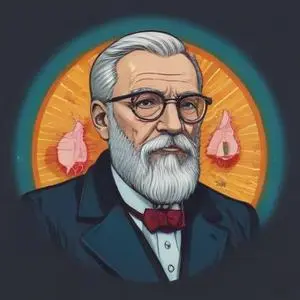
Developed the theory of phagocytosis, which describes how cells engulf and destroy foreign particles and bacteria, leading to a deeper understanding of the immune system.
Ilya Metchnikoff, a Russian zoologist of Moldavian noble ancestry, is renowned for his groundbreaking research in immunology, specifically the discovery of phagocytosis, a process where cells engulf and destroy foreign particles, and the cell responsible for it, the phagocyte. This pioneering work earned him, along with Paul Ehrlich, the 1908 Nobel Prize in Physiology or Medicine.
Born on May 3, 1845, in the Russian Empire (now modern-day Ukraine), Metchnikoff was the son of a Moldavian noble father and a Ukrainian-Jewish mother. Despite his mother's Jewish origin, he was baptized Russian Orthodox, but later became an atheist.
In 1882, Metchnikoff made a crucial discovery that would change the course of immunology. He observed that certain cells, now known as phagocytes, could engulf and destroy foreign particles, such as bacteria, in a process called phagocytosis. This discovery revealed the major defense mechanism in innate immunity and laid the foundation for the concept of cell-mediated immunity.
Metchnikoff's work on phagocytosis led to the development of the concept of innate immunity, which refers to the body's natural, non-specific defense against pathogens. This concept was a significant departure from the prevailing understanding of immunity at the time, which focused on acquired immunity through exposure to specific pathogens.
In addition to his work on immunology, Metchnikoff made significant contributions to the study of aging and longevity. He coined the term "gerontology" in 1903 and advocated for the use of lactic acid bacteria (Lactobacillus) for a healthy and long life. This concept eventually became the foundation of probiotics in medicine.
Metchnikoff's pioneering work has had a lasting impact on our understanding of immunology and aging. He is honored as the father of innate immunity and gerontology, and his work has paved the way for numerous scientific breakthroughs in these fields. In recognition of his contributions, he was awarded the Copley Medal in 1906 and the Nobel Prize in Physiology or Medicine in 1908.
Metchnikoff's remarkable journey, marked by groundbreaking discoveries and significant contributions to the fields of immunology and gerontology, continues to inspire scientists and researchers to this day.
Born in 1845
Developed the theory of phagocytosis, which describes how cells engulf and destroy foreign particles and bacteria, leading to a deeper understanding of the immune system.
Born in 1822
Developed vaccines for rabies and anthrax, and pioneered the germ theory of disease, revolutionizing our understanding of microbiology and disease prevention.
Born in 1843
A pioneering microbiologist and physician who discovered the bacteria that cause tuberculosis, cholera, and anthrax, revolutionizing the field of microbiology and saving countless lives.
Born in 1854
Developed the first vaccine against diphtheria and tetanus, revolutionizing the treatment of bacterial infections. Pioneered the field of immunology and saved countless lives.
Born in 1854
A German physician and biologist who discovered the first effective treatment for syphilis and developed the concept of chemotherapy, earning a Nobel Prize in Physiology or Medicine in 1908.
97 Years Old
A Romanian-American writer, professor, and humanitarian who survived the Holocaust and dedicated his life to promoting peace, justice, and human rights, leaving a lasting impact on literature and activism.
Born in 1856
Pioneering microbiologist and ecologist who discovered chemosynthesis, the process by which microorganisms thrive in extreme environments, and founded modern soil science. His work transformed our understanding of microbial life and ecosystems.
Born in 1881
Discovered penicillin, a revolutionary antibiotic, and pioneered its use in medicine. This breakthrough has saved countless lives and transformed the field of healthcare.
