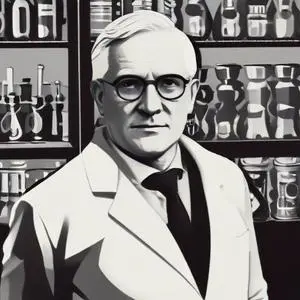
Alexander Fleming: The Scottish Physician Who Revolutionized Medicine
The Discovery of Penicillin
Alexander Fleming is renowned for his groundbreaking discovery of penicillin, the world's first broadly effective antibiotic substance, which has been hailed as the single greatest victory ever achieved over disease. In 1928, Fleming's serendipitous observation of a mold contaminating one of his bacterial cultures led to the isolation of benzylpenicillin, or penicillin G, from the mold Penicillium rubens.
Early Life and Education
Born on August 6, 1881, at Lochfield farm near Darvel, in Ayrshire, Scotland, Alexander Fleming was the third of four children of farmer Hugh Fleming and Grace Stirling Morton. After completing his primary education at Loudoun Moor School and Darvel School, Fleming earned a two-year scholarship to Kilmarnock Academy. Later, he attended the Royal Polytechnic Institution in London.
Career Highlights
- In 1903, Fleming inherited money from an uncle, John Fleming, and pursued a career in medicine, following in the footsteps of his elder brother, Tom.
- In 1922, Fleming discovered the enzyme lysozyme from his nasal discharge, along with a bacterium he named Micrococcus lysodeikticus, later renamed Micrococcus luteus.
- In 1944, Fleming was knighted for his scientific achievements.
- In 1945, Fleming shared the Nobel Prize in Physiology or Medicine with Howard Florey and Ernst Boris Chain for his discovery of penicillin.
Philosophical Contributions and Beliefs
Fleming's discovery of penicillin exemplifies the serendipitous nature of scientific research. His work highlights the importance of observation, curiosity, and persistence in the pursuit of scientific knowledge.
Influence on Modern Society
The advent of penicillin has revolutionized the treatment of bacterial infections, saving countless lives and transforming the field of medicine. Fleming's discovery has also had a profound impact on the development of modern medicine, paving the way for the creation of new antibiotics and inspiring further research into the treatment of infectious diseases.
Historical Context and Legacy
Fleming's discovery of penicillin occurred during a time when bacterial infections were a leading cause of death. His work not only saved countless lives but also transformed the field of medicine, earning him a place among the most important people of the 20th century. In 1999, Fleming was named in Time magazine's list of the 100 Most Important People of the 20th century. He was also chosen in the BBC's television poll for determining the 100 Greatest Britons in 2002 and voted third greatest Scot in an opinion poll conducted by STV in 2009.
Trivia and Fun Facts
- Fleming's discovery of penicillin was initially met with skepticism by the scientific community.
- Penicillin was first used to treat patients in 1941, nearly 13 years after Fleming's initial discovery.
- Fleming's work on penicillin was conducted in a small laboratory at St. Mary's Hospital in London.
Comparative Analysis with Contemporaries
Fleming's discovery of penicillin overshadowed the work of his contemporaries, including German chemist
Gerhard Domagk, who developed the first commercially available antibiotic, Prontosil. While Domagk's work was significant, Fleming's discovery of penicillin marked a major breakthrough in the treatment of bacterial infections.
Personal Relationships and Anecdotes
Fleming's brother, Tom, played a significant role in encouraging him to pursue a career in medicine. Fleming's discovery of penicillin was also influenced by his work with Howard Florey and Ernst Boris Chain, with whom he shared the Nobel Prize in 1945.
Awards and Honors
- Nobel Prize in Physiology or Medicine (1945)
- Knighted for his scientific achievements (1944)
- Named in Time magazine's list of the 100 Most Important People of the 20th century (1999)
- Chosen in the BBC's television poll for determining the 100 Greatest Britons (2002)
- Voted third greatest Scot in an opinion poll conducted by STV (2009)
Legacy and Impact on Medicine
Alexander Fleming's discovery of penicillin has had a profound and lasting impact on the field of medicine, revolutionizing the treatment of bacterial infections and saving countless lives. His work continues to inspire new generations of scientists and researchers, cementing his place as one of the most important scientists of the 20th century.
FAQ
What was Alexander Flemings most significant discovery?
Alexander Flemings most significant discovery was the antibacterial properties of penicillin, which revolutionized the treatment of bacterial infections and saved countless lives. He discovered penicillin in 1928, observing that a mold had contaminated one of his bacterial cultures, and isolated the substance responsible for the antibacterial effect.
How did Alexander Flemings discovery of penicillin change medicine?
Alexander Flemings discovery of penicillin changed medicine by providing a powerful tool in the fight against bacterial infections. Penicillin enabled doctors to treat a wide range of bacterial diseases, from pneumonia to meningitis, and saved countless lives.
What role did Alexander Fleming play in the development of antibiotics?
Alexander Fleming played a crucial role in the development of antibiotics, as his discovery of penicillin paved the way for the development of other antibiotics. He worked with colleagues to refine the purification and production of penicillin, making it available for widespread use.
How did Alexander Flemings work influence public health?
Alexander Flemings work influenced public health by providing a powerful tool in the control of infectious diseases. His discovery of penicillin helped reduce the incidence of bacterial infections, saving countless lives and improving overall public health.
What awards and recognition did Alexander Fleming receive for his work?
Alexander Fleming received numerous awards and recognition for his work, including the Nobel Prize in Physiology or Medicine in 1945, the Copley Medal in 1953, and knighthood in 1944. He was also elected a Fellow of the Royal Society in 1944.