


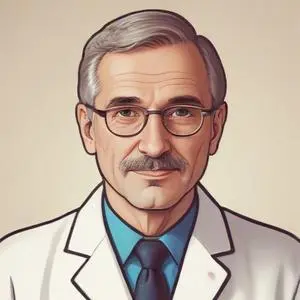
A German pathologist and bacteriologist who discovered the first commercially available antibiotic, Prontosil, revolutionizing the treatment of bacterial infections. His groundbreaking work saved countless lives and paved the way for modern medicine.
Gerhard Domagk, a renowned German pathologist and bacteriologist, is celebrated for his groundbreaking discovery of sulfonamidochrysoidine, the first commercially available antibiotic, Prontosil. This pioneering work earned him the 1939 Nobel Prize in Physiology or Medicine, revolutionizing the treatment of bacterial infections.
Born on October 30, 1895, in Lagow, Brandenburg, German Empire (now Poland), Gerhard Domagk was the second of three children to Paul Richard Domagk, a school teacher. He grew up in Sommerfeld (now Lubsko, Poland) and completed his elementary education at the Bismarck School.
In 1927, Domagk joined the IG Farben branch at Elberfeld (later Wuppertal), where he was tasked with testing chemical compounds for potential drugs. It was during this time that he discovered the antibacterial properties of sulfonamidochrysoidine, a benzene derivative of azo dye attached with sulphonamide group as a side chain.
This discovery was a result of his collaboration with Friedrich Mietzsch and Joseph Klarer, who synthesized the compound. Domagk's work led to the development of Prontosil, the first commercially available antibiotic, which revolutionized the treatment of bacterial infections.
In 1935, Domagk's only daughter, Hildegarde, contracted a streptococcal infection, which threatened to require amputation of her arm. In a desperate bid to save her, Domagk used the new compound, Prontosil, to cure her infection. This personal triumph cemented his faith in the antibiotic's potential and paved the way for its widespread use.
In 1939, Domagk was awarded the Nobel Prize in Physiology or Medicine for his discovery of the antibacterial effects of Prontosil. However, the Nazi government prohibited him from receiving the award. It wasn't until 1947, after the fall of Nazi Germany, that he was officially given the Nobel diploma and delivered the Nobel lecture.
Gerhard Domagk's discovery of Prontosil marked the beginning of a new era in antibacterial therapy. His work paved the way for the development of modern antibiotics, saving countless lives and transforming the field of medicine. Today, he is remembered as a pioneer in the fight against bacterial infections.
Gerhard Domagk married and had one daughter, Hildegarde. He passed away on April 24, 1964, leaving behind a legacy of innovation and progress in the field of medicine.
Born in 1881
Discovered penicillin, a revolutionary antibiotic, and pioneered its use in medicine. This breakthrough has saved countless lives and transformed the field of healthcare.
Born in 1906
A German-Irish biochemist and academic who discovered penicillin's antibacterial properties and developed it as a therapeutic agent, revolutionizing the treatment of bacterial infections.
Born in 1898
Developed penicillin as a medicine, revolutionizing the treatment of bacterial infections. This discovery has saved countless lives and transformed modern medicine.
Born in 1888
A pioneering biochemist and microbiologist who discovered numerous antibiotics, including streptomycin, and developed a method for producing them on a large scale. Their work revolutionized the treatment of bacterial infections.
Born in 1901
A pioneer in microbiology and environmentalism, he explored the interconnectedness of humans and their ecosystem, advocating for a holistic approach to health and conservation.
Born in 1896
A Nobel Prize-winning biochemist and pharmacologist who discovered the Cori cycle, a crucial process by which our bodies convert glucose into energy. Their work has had a lasting impact on our understanding of metabolism and disease.
Born in 1896
A pioneering scientist who discovered how the body breaks down and uses carbohydrates, earning a Nobel Prize in Physiology or Medicine in 1947. Her groundbreaking work has led to a deeper understanding of diabetes and other metabolic disorders.
Born in 1902
Pioneering geneticist who discovered transposons, mobile genetic elements that jump from one location to another in a genome, revolutionizing our understanding of genetic variation and evolution.
