


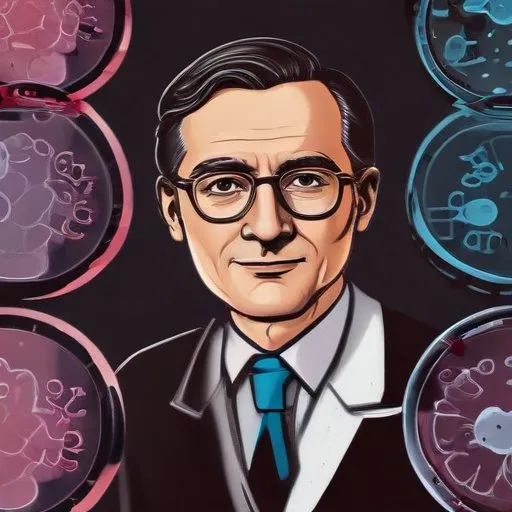
A German microbiologist invented a shallow, cylindrical dish used to culture microorganisms, revolutionizing laboratory practices and enabling groundbreaking discoveries in microbiology. This innovation has had a lasting impact on scientific research and public health.
Julius Richard Petri, a German microbiologist, is renowned for inventing the Petri dish, a device that revolutionized the field of microbiology and earned him a lasting legacy in the scientific community. This innovative tool, named after him, enabled the growth and observation of microorganisms, providing a crucial step forward in understanding and combating diseases.
Born on May 31, 1852, in Barmen, Germany (now a district of Wuppertal), Petri came from a distinguished family of scholars. His father, Philipp Ulrich Martin Petri, was a professor in Berlin, and his grandfather, Viktor Friedrich Leberecht Petri, was a director and professor at the Collegium Carolinum in Braunschweig, Germany.
Petri studied medicine at the Kaiser Wilhelm Academy for Military Physicians from 1871 to 1875 and received his medical degree in 1876. He continued his studies at the Charit Hospital in Berlin, where his thesis on the chemistry of protein urine tests earned him his doctorate.
After completing his studies, Petri served as a military physician until 1882 and then continued as a reservist. In 1886, he became a curator at the museum of hygiene and later worked under the esteemed bacteriologist Robert Koch.
During his time with Koch, Petri's work focused on developing techniques for culturing bacteria. On the suggestion of Angelina Hesse, the wife of another assistant, Walther Hesse, the Koch laboratory began using agar plates to culture bacteria. Petri's invention of the standard culture dish, or Petri plate, and his development of the technique of agar culture enabled the rigorous identification of bacteria responsible for diseases.
Petri's invention of the Petri dish had a profound impact on the field of microbiology, facilitating the discovery of new bacteria and the development of vaccines. The Petri dish became an essential tool in laboratories worldwide, allowing scientists to study microorganisms and make groundbreaking discoveries.
Petri married Anna Riesch in 1884, but tragically lost her in 1894 during childbirth. He remarried in 1897 to a woman named Martha. Despite personal setbacks, Petri remained dedicated to his work and continued to make significant contributions to the field of microbiology.
Julius Richard Petri's legacy extends far beyond his invention of the Petri dish. He was a pioneer in the field of microbiology, and his work paved the way for numerous scientific breakthroughs. In recognition of his contributions, Petri was awarded the title of secret government advisor in 1900, a position he held until his death on December 20, 1921.
Petri's invention of the Petri dish has remained an integral part of laboratory procedures, and his name has become synonymous with microbiological research. His contributions to the field of microbiology have had a lasting impact, and his legacy continues to inspire scientists and researchers today.
Julius Richard Petri's remarkable contributions to the field of microbiology have left an indelible mark on the scientific community. His invention of the Petri dish has enabled scientists to make groundbreaking discoveries, and his legacy continues to inspire future generations of researchers.
Born in 1843
A pioneering microbiologist and physician who discovered the bacteria that cause tuberculosis, cholera, and anthrax, revolutionizing the field of microbiology and saving countless lives.
Born in 1822
Developed vaccines for rabies and anthrax, and pioneered the germ theory of disease, revolutionizing our understanding of microbiology and disease prevention.
Born in 1854
Developed the first vaccine against diphtheria and tetanus, revolutionizing the treatment of bacterial infections. Pioneered the field of immunology and saved countless lives.
Born in 1845
Developed the theory of phagocytosis, which describes how cells engulf and destroy foreign particles and bacteria, leading to a deeper understanding of the immune system.
Born in 1854
A German physician and biologist who discovered the first effective treatment for syphilis and developed the concept of chemotherapy, earning a Nobel Prize in Physiology or Medicine in 1908.
Born in 1856
Pioneering microbiologist and ecologist who discovered chemosynthesis, the process by which microorganisms thrive in extreme environments, and founded modern soil science. His work transformed our understanding of microbial life and ecosystems.
Born in 1851
Pioneering microbiologist and botanist who discovered viruses, developed enrichment culture techniques, and coined the term "virus" to describe these tiny infectious agents. Their work laid the foundation for modern virology and microbiology.
Born in 1881
Discovered penicillin, a revolutionary antibiotic, and pioneered its use in medicine. This breakthrough has saved countless lives and transformed the field of healthcare.
