


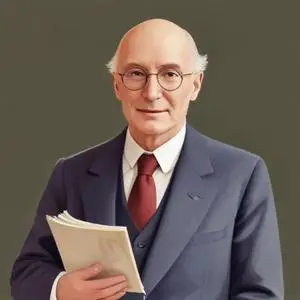
Developed groundbreaking philosophical concepts, such as process philosophy, and contributed significantly to mathematics, particularly in the fields of logic and geometry.
Alfred North Whitehead is renowned for developing the philosophical school of process philosophy, a groundbreaking concept that has been applied across various disciplines, including ecology, theology, education, physics, biology, economics, and psychology. His magnum opus, Process and Reality, is considered a foundational text in this field, offering a radically new perspective on reality and our place within it.
Born on February 15, 1861, in Ramsgate, Kent, England, Whitehead was the son of Alfred Whitehead, a Church of England priest. He received his early education at Sherborne School and later attended Trinity College, Cambridge, where he excelled in mathematics and became a Fellow in 1884.
In the early stages of his career, Whitehead focused on mathematics, logic, and physics. His collaboration with his former student, Bertrand Russell, led to the creation of the monumental three-volume work, Principia Mathematica (1910-1913). This seminal work is regarded as one of the most important contributions to mathematical logic in the 20th century, ranking 23rd in Modern Library's list of the top 100 English-language nonfiction books of the 20th century.
In the late 1910s and early 1920s, Whitehead's intellectual pursuits shifted from mathematics to philosophy of science and eventually metaphysics. He developed a comprehensive metaphysical system that departed significantly from traditional Western philosophy. Whitehead's process philosophy argues that reality consists of processes rather than material objects, with these processes defined by their relations with other processes. This perspective rejects the notion that reality is constructed from independent, self-contained bits of matter.
Whitehead's process philosophy emphasizes the interconnectedness of processes, highlighting the importance of understanding the world as a web of interrelated events. His ideas have far-reaching implications for various fields, including:
Whitehead was awarded the Order of Merit in 1945, a prestigious honor bestowed upon individuals who have made exceptional contributions to the arts, sciences, and humanities. He also served as the president of the Aristotelian Society from 1922 to 1923.
Alfred North Whitehead's process philosophy has had a profound impact on modern thought, influencing generations of scholars, philosophers, and thinkers. His ideas continue to inspire new perspectives in various fields, from ecology and theology to education and physics. As we navigate the complexities of the 21st century, Whitehead's emphasis on interconnectedness and process remains a powerful clarion call to re-examine our understanding of reality and our place within it.
"The universe is not a collection of distinct things, but a continuum, where everything blends into everything else."
"The only way of understanding the world is to look for the meaning of the world."
"The task of philosophy is to recover the totality of experience."
Born in 1872
A renowned thinker who made significant contributions to mathematics, philosophy, and social commentary, known for his influential writings on logic, ethics, and politics. He's a prominent figure in shaping modern intellectual thought.
Born in 1848
Developed a formal system of logic and introduced modern mathematical notation, laying the groundwork for modern logic, mathematics, and computer science.
Born in 1862
A renowned mathematician and academic who developed infinite-dimensional vector spaces and laid the foundation for quantum mechanics and relativity. He's also famous for his 23 unsolved math problems that shaped 20th-century mathematics.
Born in 1906
A groundbreaking logician and philosopher who shook the foundations of mathematics with his incompleteness theorems, proving that no formal system can be both complete and consistent.
Born in 1724
Developed influential philosophical frameworks, such as the Critique of Pure Reason, that shaped modern Western thought on ethics, morality, and human understanding.
Born in 1845
Developed set theory, introducing infinite sets and cardinal numbers, revolutionizing mathematics and philosophy.
44 Years Old
Mozambican professional footballer who played as a defender and won several titles with his club, including the CAF Champions League. He's known for his skills and achievements in African football.
