


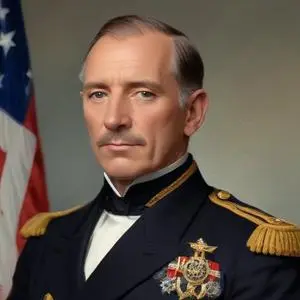
A naval strategist and historian who wrote influential books on the importance of sea power in international relations, shaping modern naval warfare and global politics.
Alfred Thayer Mahan, a celebrated American naval officer and historian, is renowned for his groundbreaking work on the significance of sea power in shaping global politics and conflicts. His seminal book, The Influence of Sea Power Upon History, 1660-1783, published in 1890, won immediate recognition and catapulted him to international fame.
Born on September 27, 1840, at West Point, New York, Mahan was the son of Dennis Hart Mahan, a prominent professor at the United States Military Academy, and Mary Helena Okill Mahan. He was named in honor of the "Father of West Point," Sylvanus Thayer. Mahan attended Saint James School, an Episcopal college preparatory academy in western Maryland, before studying at Columbia for two years. He was an active member of the Philolexian Society debating club during his time at Columbia.
Against his father's wishes, Mahan entered the U.S. Naval Academy, where he graduated second in his class in 1859. He began his naval career as an officer on the frigate Congress and later served on the steam corvette Pocahontas, participating in the Battle of Port Royal during the American Civil War. Mahan's service continued as an instructor at the Naval Academy, and he eventually rose through the ranks, becoming a lieutenant in 1861, lieutenant commander in 1865, commander in 1872, and captain in 1885.
Mahan's magnum opus, The Influence of Sea Power Upon History, 1660-1783, is a comprehensive analysis of the role of naval power in shaping the course of history. The book's publication in 1890 sparked widespread interest and acclaim, particularly in Europe. Its successor, The Influence of Sea Power Upon the French Revolution and Empire, 1793-1812, published in 1892, further solidified Mahan's reputation as a leading naval strategist.
Mahan's work was instrumental in shaping the development of modern naval warfare. His theories on the importance of sea power in international relations and conflict were influential in the formation of naval policies in the United States and Europe. Mahan's legacy extends beyond his literary contributions, as he played a significant role in shaping the United States' naval strategy in the late 19th and early 20th centuries.
_"The history of sea power is largely a history of contests for trade and territory, and of the struggles for the possession of the seas."_ - Alfred Thayer Mahan
With his groundbreaking work, Alfred Thayer Mahan left an indelible mark on the development of modern naval warfare. His theories and writings continue to influence naval strategists and historians to this day, cementing his place as one of the most important American strategists of the 19th century.
Born in 1858
A pioneering leader who championed progressive reforms, trust-busting, and conservation, earning a Nobel Peace Prize for mediating the Russo-Japanese War. He's also famous for his rugged outdoorsmanship and "big stick" diplomacy.
Born in 1837
Led the U.S. Navy to a decisive victory in the Battle of Manila Bay during the Spanish-American War, earning him international acclaim and the rank of Admiral of the Navy. He is remembered as a hero and a symbol of American naval power.
Born in 1843
The 25th President of the United States, a strong leader who championed high tariffs and annexed Hawaii, is most known for being assassinated at the 1901 World's Fair. He played a significant role in shaping the country's economy and foreign policy.
Born in 1918
A South African lawyer and politician who fought against apartheid, becoming the country's first black president and a symbol of racial reconciliation, earning a Nobel Peace Prize. He's a beacon of hope and freedom.
Born in 1871
Prolific writer of historical novels and adventure stories, also a talented landscape painter.
Born in 1882
Led the United States through the Great Depression and World War II, implementing a series of reforms known as the New Deal and helping to establish the country as a global superpower.
Born in 1878
The Soviet Union's ruthless leader who ruled with an iron fist, implementing policies that led to widespread famine and purges, while also playing a crucial role in defeating Nazi Germany in World War II.
Born in 1890
Led the Allied forces to victory in World War II and later served as President, maintaining peace and prosperity during the Cold War era. He's known for his strategic leadership and diplomatic skills.
