


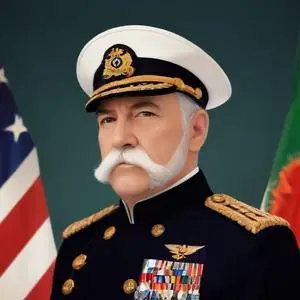
Led the U.S. Navy to a decisive victory in the Battle of Manila Bay during the Spanish-American War, earning him international acclaim and the rank of Admiral of the Navy. He is remembered as a hero and a symbol of American naval power.
George Dewey is an American naval legend, best known for his daring victory at the Battle of Manila Bay during the Spanish-American War, which earned him the rank of Admiral of the Navy, the highest naval rank in the United States. This pivotal battle marked a turning point in the war, cementing Dewey's place in American history as a brilliant and fearless commander.
Born on December 26, 1837, in Montpelier, Vermont, Dewey's early life was marked by adventure and rebellion. At the age of 15, his father enrolled him at Norwich University in Northfield, Vermont. However, Dewey's time at Norwich was short-lived, as he was expelled two years later for drunkenness and herding sheep into the barracks.
Undeterred, Dewey's father helped him secure an appointment to the United States Naval Academy in 1854. Dewey graduated from the academy in 1858 and was assigned as the executive lieutenant of the USS Mississippi, where he would participate in the capture of New Orleans and the Siege of Port Hudson during the American Civil War.
Dewey's experience during the Civil War was instrumental in shaping his leadership skills and strategic thinking. By the end of the war, he had reached the rank of lieutenant commander and went on to undertake a variety of assignments, serving on multiple ships, including the USS Constitution, and as an instructor at the Naval Academy.
He also served on the United States Lighthouse Board and the Board of Inspection and Survey, demonstrating his versatility and commitment to the naval service. In 1896, Dewey was promoted to commodore and assigned to the Asiatic Squadron the following year, where he began preparations for a potential war with Spain.
When the Spanish-American War broke out in April 1898, Dewey led an attack on Manila Bay, sinking or capturing the entire Spanish Pacific fleet while suffering only minor casualties. This decisive victory marked a turning point in the war, and Dewey's heroic actions earned him widespread acclaim in the United States.
After the battle, Dewey's fleet assisted in the capture of Manila, and he was promoted to Admiral of the Navy in 1903, the highest naval rank in the United States. This promotion cemented his status as a national hero and a brilliant naval commander.
In addition to his naval career, Dewey explored a run for the 1900 Democratic presidential nomination, but he withdrew from the race and endorsed President William McKinley. He served on the General Board of the United States Navy, an important policymaking body, from 1900 until his death in 1917.
Dewey's legacy extends beyond his military achievements. He is remembered as a pioneering figure in American naval history, a symbol of patriotism and bravery. His name is immortalized in various forms, including the USS Dewey, a destroyer commissioned in 1900, and the Dewey Decimal Classification system, developed by Melvil Dewey, a distant relative.
Today, George Dewey is remembered as a hero, a patriot, and a brilliant naval commander. His legacy continues to inspire generations of Americans, and his name is synonymous with bravery, leadership, and sacrifice.
Born in 1885
Led the U.S. Pacific Fleet to victory in World War II, playing a crucial role in defeating Japan and ending the war. He was a highly respected and decorated naval leader.
Born in 1874
A prominent publisher and politician who served as the 46th Secretary of the Navy, playing a crucial role in preparing the US Navy for World War II. He's most known for his efforts in modernizing the Navy and increasing its strength during wartime.
Born in 1871
A prominent diplomat who played a crucial role in establishing the United Nations and was awarded the Nobel Peace Prize in 1945 for his efforts to promote international cooperation. He served as Secretary of State from 1933 to 1944, implementing policies that helped shape the post-World War II world order.
Born in 1867
A prominent figure in American politics, serving as Secretary of State and playing a key role in shaping foreign policy during World War II. He's also known for his advocacy of international cooperation and collective security.
Born in 1880
A highly decorated military leader and statesman who played a crucial role in shaping post-WWII foreign policy and was awarded the Nobel Peace Prize for his efforts. He's most known for authoring the Marshall Plan, a massive economic aid program that helped rebuild war-torn Europe.
Born in 1880
A highly decorated war hero and master strategist who led troops to victory in World War I and II, and later became a prominent figure in the occupation of Japan.
Born in 1886
A highly decorated naval officer who played a crucial role in several key battles in World War II, including the Battle of Midway, and later served as a diplomat.
