


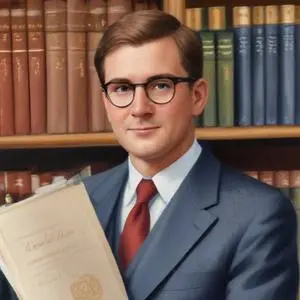
Creator of the Dewey Decimal System, a widely used method for organizing books and other materials in libraries, making it easier for people to find what they need. This system has become a standard in libraries worldwide.
Melvil Dewey, the trailblazing American librarian and educator, is renowned for inventing the Dewey Decimal Classification system, a cornerstone of modern librarianship. This groundbreaking system has become an indispensable tool for organizing and retrieving books, facilitating access to knowledge for millions worldwide.
Born on December 10, 1851, in Adams Center, New York, Melvil Dewey was the fifth and last child of Joel and Eliza Greene Dewey. He attended rural schools and was driven by a passion to reform education, recognizing its transformative power. Dewey's academic pursuits took him to Alfred University (1870) and Amherst College, where he earned his bachelor's (1874) and master's degrees (1877).
In 1876, while still a student, Dewey pioneered the development of the Dewey Decimal Classification system. This innovative system assigned a numerical classification to books, making it easier to locate and categorize them. The system's effectiveness was immediate, and its adoption spread rapidly across libraries in the United States.
Dewey's dedication to education and librarianship led him to hold prominent positions, including chief librarian at Columbia University Libraries (1883-1888) and director of the New York State Library (1888-1906). During his tenure, he introduced the concept of traveling libraries, bringing books to underserved communities. As secretary and executive officer of the University of the State of New York (1888-1900), Dewey continued to advocate for education reform and library development.
In 1895, Dewey co-founded the Lake Placid Club with his wife Annie. This exclusive resort community in upstate New York became a hub for winter sports, with Dewey's son Godfrey playing a key role in organizing the Winter Olympics. Dewey chaired the New York State Winter Olympics Committee, solidifying his connection to this iconic event.
Dewey's personal life was marked by two marriages, first to Annie R. Godfrey and then to Emily McLaren. However, his legacy has been marred by allegations of sexual harassment, racism, and antisemitism. These controversies have led to a reevaluation of Dewey's contributions, highlighting the complexities of his character.
Despite the controversies surrounding his personal life, Melvil Dewey's impact on modern librarianship and education remains unparalleled. The Dewey Decimal System continues to influence library classification systems worldwide, making knowledge more accessible than ever before. Dewey's commitment to education, advocacy, and innovation has inspired generations of librarians, educators, and scholars.
In recognition of his contributions, Dewey received numerous awards and honors, including an honorary doctorate from Amherst College (1889) and election as a fellow of the American Academy of Arts and Sciences (1900).
| 1851 | Born on December 10th in Adams Center, New York |
| 1870 | Attended Alfred University |
| 1874 | Earned bachelor's degree from Amherst College |
| 1876 | Invented the Dewey Decimal Classification system |
| 1883-1888 | Served as chief librarian at Columbia University Libraries |
| 1888-1906 | DIRECTOR of the New York State Library |
| 1895 | Co-founded the Lake Placid Club |
| 1926 | Established a new branch of the Lake Placid Club in Florida |
Melvil Dewey's remarkable life and achievements continue to shape the world of librarianship, education, and beyond. His legacy serves as a testament to the power of innovation, advocacy, and public service.
Born in 1835
A self-made industrialist who amassed a vast fortune in the steel industry, then donated most of it to fund over 2,500 public libraries and other philanthropic endeavors.
Born in 1859
Developed pragmatic philosophy and progressive education theories, focusing on hands-on learning and social reform. Known for his influential ideas on democracy, education, and individual freedom.
Born in 1861
The 8th Librarian of Congress was a pioneering figure in American library development, credited with modernizing the Library of Congress and expanding its collections. He also played a key role in establishing the Copyright Office.
Born in 1837
Developed the Cutter Classification system, a method of organizing library materials that is still used today.
Born in 1871
Designed iconic locomotives for the Great Western Railway, including the Castle and King classes, which revolutionized British rail travel. His designs balanced aesthetics with functionality, earning him a lasting legacy in railway engineering.
