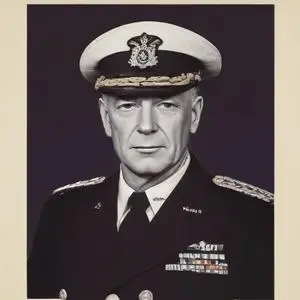
Chester W. Nimitz: The Fleet Admiral Who Shaped the US Navy
The Leading Authority on Submarines and Mastermind of World War II
Chester W. Nimitz is renowned as the fleet admiral who played a crucial role in the Allied victory in World War II, spearheading the US Navy's efforts as Commander in Chief, US Pacific Fleet, and Commander in Chief, Pacific Ocean Areas. He is also remembered as the leading US Navy authority on submarines, instrumental in converting their propulsion from gasoline to diesel and later overseeing the development of the world's first nuclear-powered submarine, USS Nautilus.
Early Life and Education
Born on February 24, 1885, in Fredericksburg, Texas, Chester Nimitz was the son of Anna Josephine Henke and Chester Bernhard Nimitz. His father, a frail and rheumatic man, passed away just six months before Nimitz's birth. In 1890, his mother married William Nimitz, his father's brother. Nimitz's German-born paternal grandfather, Charles Henry Nimitz, a former seaman in the German Merchant Marine, had a profound influence on him. Charles instilled in Nimitz the value of hard work and perseverance, teaching him that "the sea, like life itself, is a stern taskmaster. The best way to get along with either is to learn all you can, then do your best and don't worry – especially about things over which you have no control."
Career Highlights and Major Works
Nimitz's naval career spanned over five decades, during which he left an indelible mark on the US Navy. Some of his notable achievements include:
- Overseeing the conversion of submarines from gasoline to diesel propulsion, significantly increasing their range and effectiveness.
- Playing a key role in the development of the world's first nuclear-powered submarine, USS Nautilus.
- Pioneering underway replenishment techniques, enabling the US fleet to operate away from port almost indefinitely.
- Serving as the Chief of the Navy's Bureau of Navigation in 1939.
- Becoming the Chief of Naval Operations from 1945 to 1947.
Philosophical Contributions and Beliefs
Nimitz's leadership philosophy was rooted in his grandfather's advice. He believed in the importance of knowledge, hard work, and adaptability. According to Nimitz, "The best way to get along with either [the sea or life] is to learn all you can, then do your best and don't worry – especially about things over which you have no control." This mantra guided his decision-making throughout his career.
Legacy and Honors
Nimitz's contributions to the US Navy and his country earned him numerous accolades, including:
- Being the United States' last surviving officer to hold the rank of fleet admiral.
- Having the USS Nimitz supercarrier, the lead ship of her class, named after him.
- Being awarded the Distinguished Service Medal, the Navy Cross, and the Legion of Merit, among others.
Personal Milestones and Key Life Events
Some significant personal milestones in Nimitz's life include:
- His marriage to Catherine Vance Freeman in 1913, with whom he had four children.
- His promotion to fleet admiral in 1944, becoming the third officer to achieve this rank in US Navy history.
- His passing on February 20, 1966, at the age of 80, leaving behind a legacy that continues to inspire future generations of naval officers.
Influence on Modern Society
Chester W. Nimitz's remarkable career and achievements have had a profound impact on modern society. His pioneering work in submarine development and underway replenishment techniques paved the way for the US Navy's continued dominance in the world's oceans. Furthermore, his leadership philosophy and emphasis on education and adaptability have inspired countless individuals, both in and out of the military.
By explororing the remarkable life and career of Chester W. Nimitz, we are reminded of the importance of perseverance, hard work, and innovative thinking. His legacy continues to inspire us to strive for excellence and push the boundaries of what is possible.
FAQ
What was Chester W. Nimitzs role in World War II?
Chester W. Nimitz played a crucial role in World War II as the Commander-in-Chief of the Pacific Fleet, leading the Allied forces to victory against Japan. He was also the Chief of Naval Operations from 1945 to 1947.
What awards did Chester W. Nimitz receive for his military service?
Chester W. Nimitz received numerous awards for his military service, including the Navy Distinguished Service Medal, the Army Distinguished Service Medal, and the Legion of Merit.
Where is Chester W. Nimitzs hometown?
Chester W. Nimitz was born in Fredericksburg, Texas, and grew up in Kerrville, Texas.
What was Chester W. Nimitzs personality like?
Chester W. Nimitz was known for his calm and reserved personality, which earned him the nickname The Quiet Admiral. He was also a skilled leader and strategist.
What is Chester W. Nimitzs legacy in the US Navy?
Chester W. Nimitzs legacy in the US Navy is that of a highly respected leader and strategist who played a crucial role in the Allied victory in World War II. He is also remembered for his role in shaping the modern US Navy.