


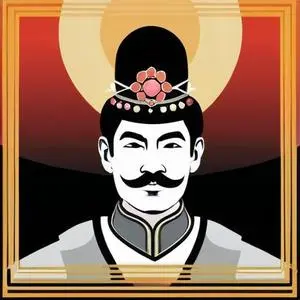
The Japanese emperor who ruled from 1926 to 1989, leading the country through World War II and its post-war reconstruction, and is known for his symbolic role in Japanese politics and culture. He is also remembered for his rare public apology for Japan's wartime atrocities.
Hirohito, posthumously honored as Emperor Shōwa, is renowned for his unprecedented 62-year reign as the 124th emperor of Japan, making him one of the longest-reigning monarchs in the world. His remarkable tenure spanned from 1926 to 1989, leaving an indelible mark on Japan's modernization, international relations, and imperial lineage.
Born on April 29, 1901, in Aoyama, Tokyo, Hirohito was the first child of Crown Prince Yoshihito and Crown Princess Sadako. His frailty led to an emphasis on physical health during his education, alongside values of frugality and devotion to duty. Hirohito's early military commissions and education under influential figures shaped his perspective on Japan's divine imperial lineage and its role in modernization and diplomacy.
Proclaimed crown prince in 1916, Hirohito's overseas visits in 1921 to Western Europe marked a significant step towards international diplomacy for Japan, despite domestic opposition. His experiences abroad, particularly in Britain and meeting with European monarchs, influenced his understanding of international relations and Japan's position on the global stage.
Hirohito assumed regency in 1921 due to his father's health issues, navigating Japan through significant treaties, the 1923 Great Kantō earthquake, and an assassination attempt. In January 1924, he married Princess Nagako Kuni, and their marriage further solidified his position within the imperial family and Japanese society.
When his father died in December 1926, Hirohito, then 25 years old, became emperor of Japan. He reigned as a constitutional monarch and was the head of state, symbolizing the unity and continuity of the Japanese state. Hirohito introduced reforms to modernize the imperial system, while maintaining its traditional essence.
Hirohito's role during World War II remains a subject of controversy, with some attributing Japan's aggressive expansion to his imperial authority. However, after Japan's defeat, Hirohito cooperated with the Allied powers, and his post-war reign saw significant reforms, demilitarization, and democratization of Japan. He became a symbol of national unity and reconciliation, visiting the Atomic Bomb Memorial Museum in Hiroshima in 1964.
Hirohito had seven children with Princess Nagako, and his marriage lasted for over 65 years. He was an avid marine biologist and published several papers on the subject. Hirohito's legacy is complex, with some viewing him as a symbol of Japan's imperial past, while others see him as a unifying figure who navigated Japan through tumultuous times.
Hirohito believed in the importance of the imperial lineage and Japan's unique cultural heritage. He promoted the concept of "kokutai," or the national polity, which emphasized the emperor's role as a symbol of national unity.
Hirohito's reign saw significant social changes, including the expansion of education, women's rights, and labor movements. He also played a crucial role in promoting international relations, particularly with the United States and Europe.
Hirohito's reign spanned a tumultuous period in Japanese history, from the rise of militarism to post-war reconstruction. His legacy continues to be debated among historians, with some viewing him as a catalyst for Japan's modernization, while others criticize his role during World War II.
Hirohito's reign can be compared to that of other notable monarchs, such as King George VI of the United Kingdom and Emperor Haile Selassie of Ethiopia, who also navigated their countries through significant challenges during the 20th century.
Born in 1884
Led the Imperial Japanese Navy during World War II, masterminding the surprise attack on Pearl Harbor, and later became a symbol of Japanese military power and strategy.
Born in 1887
Led the Nationalist Party in China, fighting against the Communist Party and later establishing the government of Taiwan. He's known for his role in shaping modern Chinese history.
Born in 1893
Leader of the Chinese Communist Party who implemented radical social and economic reforms, including the Great Leap Forward and the Cultural Revolution, shaping modern China's politics and economy.
Born in 1878
The Soviet Union's ruthless leader who ruled with an iron fist, implementing policies that led to widespread famine and purges, while also playing a crucial role in defeating Nazi Germany in World War II.
Born in 1871
Prolific writer of historical novels and adventure stories, also a talented landscape painter.
Born in 1882
Led the United States through the Great Depression and World War II, implementing a series of reforms known as the New Deal and helping to establish the country as a global superpower.
Born in 1880
A highly decorated war hero and master strategist who led troops to victory in World War I and II, and later became a prominent figure in the occupation of Japan.
