


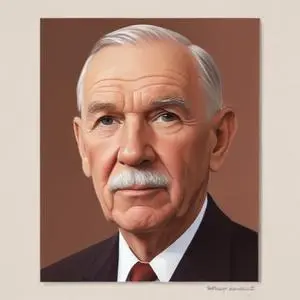
A highly decorated military leader and statesman who played a crucial role in shaping post-WWII foreign policy and was awarded the Nobel Peace Prize for his efforts. He's most known for authoring the Marshall Plan, a massive economic aid program that helped rebuild war-torn Europe.
George Catlett Marshall Jr. was an American army general and statesman who played a pivotal role in shaping the course of World War II and the post-war world order. As the Chief of Staff of the United States Army during World War II, Marshall was the mastermind behind the Allied victory, earning him the title of "the organizer of victory."
Marshall was born on December 31, 1880, in Uniontown, Pennsylvania. He graduated from the Virginia Military Institute in 1901 and began his military career as a second lieutenant in the United States Army. Marshall's early years in the army were marked by his service in the Philippines during the Philippine-American War and later in France during World War I.
In 1939, Marshall was appointed as the Chief of Staff of the United States Army, a position he held until 1945. During this time, he played a crucial role in mobilizing and preparing the American military for entry into World War II. Marshall's strategic thinking, leadership skills, and ability to work with other military leaders earned him the respect and admiration of President Franklin D. Roosevelt, who referred to him as "my Army chief of staff."
After the war, Marshall was appointed as the Secretary of State by President Harry S. Truman. In 1947, he proposed the European Recovery Program, popularly known as the Marshall Plan, which aimed to provide economic aid to war-torn Europe. The plan was a massive success, providing over $12 billion in aid to 16 European countries and helping to stabilize the region.
Marshall's contributions to the Allied victory and his role in shaping the post-war world order earned him numerous awards and honors. He was awarded the Distinguished Service Medal, the Silver Star, and the Legion of Merit, among others. In 1953, Marshall was awarded the Nobel Peace Prize for his role in promoting European recovery and stability.
Marshall married Elizabeth Cole in 1902, and the couple had no children. He was known for his integrity, humility, and strong sense of duty. Marshall died on October 16, 1959, and was buried in Arlington National Cemetery.
"Don't fight the problem, decide it."
"In my position, it is necessary to seem wise, even when one is not."
Marshall's legacy extends far beyond his military and diplomatic achievements. The Marshall Plan helped to lay the foundations for the European Union and the modern European economy. His emphasis on international cooperation and collective security has inspired generations of leaders and policymakers.
Marshall's life and career spanned a tumultuous period in world history, from the dawn of the 20th century to the early years of the Cold War. His leadership and vision helped to shape the course of World War II and the post-war world order. As a statesman, strategist, and diplomat, Marshall's legacy continues to inspire and inform leaders around the world.
Born in 1890
Led the Allied forces to victory in World War II and later served as President, maintaining peace and prosperity during the Cold War era. He's known for his strategic leadership and diplomatic skills.
Born in 1884
The 33rd President of the United States, a strong leader who made tough decisions, including dropping atomic bombs on Japan and establishing the Marshall Plan to rebuild Europe after WWII.
Born in 1882
Led the United States through the Great Depression and World War II, implementing a series of reforms known as the New Deal and helping to establish the country as a global superpower.
Born in 1871
Prolific writer of historical novels and adventure stories, also a talented landscape painter.
Born in 1878
The Soviet Union's ruthless leader who ruled with an iron fist, implementing policies that led to widespread famine and purges, while also playing a crucial role in defeating Nazi Germany in World War II.
Born in 1885
A renowned military leader who played a crucial role in World War II, particularly in the Allied victory in Europe, known for his bold tactics and unapologetic style.
Born in 1893
Led the US Army in World War II and became the last five-star general, playing a crucial role in shaping post-war American military strategy. He's also known for his humble and unassuming leadership style.
Born in 1898
American general who played a crucial role in post-WWII Germany, overseeing the Berlin Airlift and helping to establish the country's post-war government. He's also known for his efforts to rebuild and democratize Germany.
