


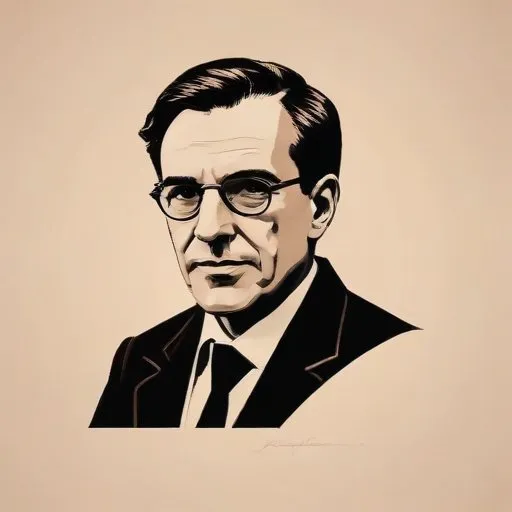
Founder of modern Spiritism, a philosophical doctrine that emphasizes the possibility of communication with the dead, and author of influential books on the subject.
Allan Kardec, the pen name of Hippolyte Léon Denizard Rivail, is renowned for his groundbreaking work in the realm of Spiritism, a philosophical and religious movement that has captivated millions worldwide. As the author of the five books known as the Spiritist Codification, Kardec's teachings have transcended borders, languages, and cultures, leaving an indelible mark on modern spirituality.
Born on October 3, 1804, in Lyon, France, Kardec was raised in a Roman Catholic family. His intellectual curiosity and thirst for knowledge led him to pursue interests in philosophy, sciences, and languages. He became an acolyte and colleague of Johann Heinrich Pestalozzi, a Swiss educator and pedagogue. Kardec's academic accomplishments were impressive, with a Bachelor of Arts and a doctorate in medicine. He was also fluent in multiple languages, including German, English, Italian, and Spanish.
Kardec's professional journey was marked by his membership in various scholarly societies, including the Historic Institute of Paris, Society of Natural Sciences of France, and the Royal Academy of Arras. He organized and taught free courses for the underprivileged, solidifying his commitment to education and social welfare. His work with Pestalozzi helped lay the foundations for the teaching model in schools in France and Germany.
As a prolific writer and translator, Kardec's literary contributions were instrumental in advancing Pestalozzi's pedagogy in France. He founded schools, worked as a teacher, and authored educational materials that had a profound impact on the French education system.
Kardec's most notable achievement is the creation of the Spiritist Codification, a comprehensive series of five books that form the basis of Spiritism. These works, written between 1857 and 1868, encompass:
These texts provide a detailed exploration of the Spiritist doctrine, which emphasizes the existence of spirits, reincarnation, and the possibility of communication with the dead. Kardec's work has been instrumental in shaping the beliefs and practices of Spiritism, a movement that has spread across the globe.
Kardec's philosophical framework is rooted in the belief that spirits are immortal and eternal, and that they evolve through a process of reincarnation. He posited that the material world is merely a temporary stage in the spirit's journey, and that the ultimate goal is spiritual perfection. Kardec's teachings also emphasize the importance of charity, fraternity, and moral development.
Kardec's legacy extends far beyond the realm of Spiritism. His work has influenced various aspects of modern society, including education, psychology, and philosophy. His emphasis on the importance of moral development and social welfare has inspired generations of educators, social reformers, and philanthropists.
Kardec's teachings have also had a profound impact on popular culture, with many artists, writers, and musicians drawing inspiration from his work. His legacy continues to inspire and influence people from all walks of life, ensuring that his message of love, compassion, and spiritual growth remains relevant in today's world.
Kardec's life was marked by significant events that shaped his worldview and philosophical outlook. His interest in Protestantism, which began during his education in Switzerland, played a crucial role in his spiritual development. His experience as a teacher, educator, and social reformer laid the foundation for his later work in Spiritism.
Kardec passed away on March 31, 1869, leaving behind a rich legacy that continues to inspire and guide millions of people worldwide. His unwavering commitment to education, social welfare, and spiritual growth has cemented his place as one of the most influential thinkers of the 19th century.
Born in 1896
French poet and author who founded Surrealism, a cultural movement that explored the subconscious and the world of dreams. He wrote novels, poems, and essays that continue to influence art and literature today.
Born in 1875
A renowned occultist and mystic who wrote extensively on magic, mysticism, and thelema, and is often associated with the phrase "Do what thou wilt shall be the whole of the Law."
Born in 1881
A French priest who merged spirituality with science, exploring the intersection of faith and evolution, and proposing a cosmic vision of human destiny. He's famous for his book "The Phenomenon of Man".
