


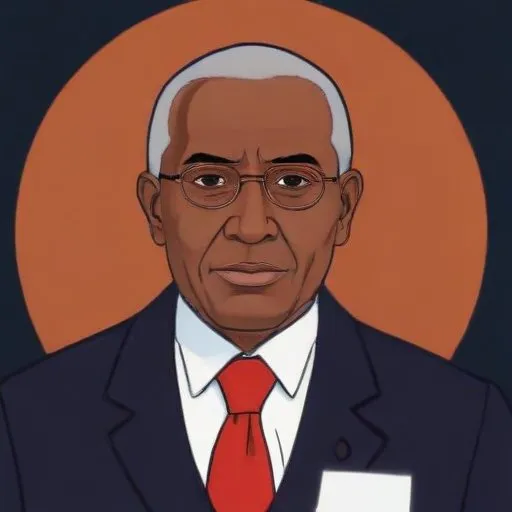
The 6th President of Zanzibar, a skilled accountant and politician, led the island nation to independence and unity with Tanganyika, shaping its modern identity. He's remembered for his efforts to balance economic growth with social justice.
Amani Abeid Karume is a renowned Tanzanian politician who served as the President of Zanzibar from 2000 to 2010, making him the longest-serving president of the semi-autonomous archipelago. As the son of Zanzibar's first president, Abeid Karume, Amani Abeid Karume's life has been intertwined with the politics and governance of Zanzibar.
Born on November 1, 1948, Amani Abeid Karume was schooled at the Lumumba Secondary School until 1969. He then pursued a career in accounting, becoming a certified accountant and working in various positions in the Revolutionary Government of Zanzibar.
During the 1970s, Karume held several prominent positions, including Chief Treasurer (1970-1971), Principal Secretary in the Ministry of Finance (1971-1974), Principal Secretary in the Ministry of Planning (1974-1978), and Principal Secretary in the Ministry of Communications and Transport (1978-1980). His experience in these roles laid the foundation for his future success in politics.
Karume's entry into politics began in 1990 when he was elected to the Zanzibar House of Representatives from the Raha Leo constituency. He was re-elected in 1995 and went on to become the Minister of Trade (1990-1995) and then the Minister of Communication and Transportation (1995-2000) under President Salmin Amour.
In 2000, Karume contested the presidential election and won 67.04% of the vote, becoming the President of Zanzibar. His presidency was marked by controversy, particularly in the 2000 and 2005 elections, which were marred by irregularities and criticized by international observers.
Despite the controversies surrounding his presidency, Karume's leadership was marked by significant economic growth and development in Zanzibar. He implemented policies aimed at promoting tourism, agriculture, and infrastructure development, which contributed to the archipelago's growth.
Karume's presidency also saw an increase in investment in education and healthcare, leading to improvements in the overall well-being of the Zanzibari people. His commitment to preserving the cultural heritage of Zanzibar earned him recognition as a champion of cultural preservation.
Amani Abeid Karume is a devout Muslim and is married with children. He is known for his charismatic personality and his ability to connect with people from all walks of life.
Despite facing criticism and controversy during his presidency, Karume remains a respected figure in Zanzibari politics and a testament to the legacy of his father, Abeid Karume.
Amani Abeid Karume's legacy extends beyond his presidency. He has inspired a new generation of leaders in Zanzibar and has contributed significantly to the development of the archipelago. His commitment to preserving the cultural heritage of Zanzibar has ensured that the island's rich history and traditions are preserved for future generations.
In conclusion, Amani Abeid Karume is a complex figure whose life has been shaped by his family's legacy and his own experiences in politics. While controversy has surrounded his presidency, his contributions to Zanzibar's growth and development cannot be ignored. His story serves as a testament to the power of leadership and the importance of preserving cultural heritage.
82 Years Old
The 2nd Chief Minister of Zanzibar, a key figure in the island's struggle for independence and unity with mainland Tanzania, known for his efforts to balance local autonomy with national unity.
75 Years Old
A Tanzanian leader who served as President from 2005 to 2015, known for his efforts to strengthen the country's economy and promote regional stability. He also played a key role in the East African Community.
87 Years Old
A Tanzanian journalist and politician who served as the 3rd President of Tanzania, known for his efforts to stabilize the country's economy and promote regional peace. He implemented economic reforms, attracting foreign investment and reducing poverty.
