


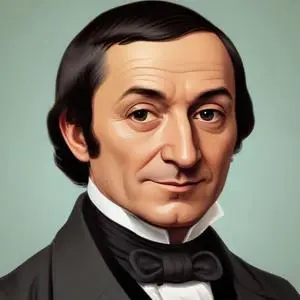
Formulated the molecular hypothesis, which states that equal volumes of gases at the same temperature and pressure contain an equal number of molecules. This concept is fundamental to understanding chemistry and physics.
Amedeo Avogadro, an Italian scientist, is renowned for his groundbreaking contribution to molecular theory, which has become a cornerstone of modern chemistry. Specifically, he is credited with the discovery of Avogadro's Law, which states that equal volumes of gases under the same conditions of temperature and pressure will contain equal numbers of molecules.
Avogadro was born on August 9, 1776, in Turin, Kingdom of Sardinia (now part of Italy), to a noble family. He graduated in ecclesiastical law at the age of 20 and briefly practiced law before devoting himself to physics and mathematics, then referred to as "positive philosophy."
In 1809, Avogadro began teaching physics and mathematics at a high school in Vercelli, where his family resided. It was during this period that he published his seminal work, "Essai d'une manière de déterminer les masses relatives des molécules élémentaires des corps, et les proportions selon lesquelles elles entrent dans ces combinaisons" (Essay on a Method of Determining the Relative Masses of the Elementary Molecules of Bodies and the Proportions by Which They Enter These Combinations) in 1811. This paper introduced Avogadro's hypothesis, which posited that equal volumes of gases contain an equal number of molecules.
Avogadro's work went largely unnoticed during his lifetime, but his hypothesis was later developed and popularized by other scientists, such as Stanislao Cannizzaro. In 1820, Avogadro became a professor of physics at the University of Turin, where he continued to teach and conduct research.
In tribute to Avogadro's groundbreaking work, the ratio of the number of elementary entities (atoms, molecules, ions, or other particles) in a substance to its amount of substance (measured in moles) is known as the Avogadro constant (NA). This constant, denoted by NA, is equal to 6.022140761023 x 10²³ mol-1 and is one of the seven defining constants of the International System of Units (SI).
Avogadro's work occurred during a time of significant scientific progress, with the development of atomic theory and the discovery of the laws of thermodynamics. His hypothesis, although initially overlooked, laid the foundation for the development of modern chemistry and physics. Today, Avogadro's Law and the Avogadro constant are fundamental principles in chemistry, physics, and engineering, with far-reaching implications for fields such as materials science, pharmaceuticals, and chemical engineering.
Avogadro was actively involved in the revolutionary movement of March 1821, which led to his temporary loss of his professorship at the University of Turin. Despite this setback, he continued to teach and conduct research, making significant contributions to the fields of physics and chemistry.
Throughout his life, Avogadro demonstrated a profound commitment to scientific inquiry and education, leaving behind a legacy that has shaped the course of modern science.
Avogadro's work has had a profound impact on modern society, with applications in industries such as:
Avogadro's Law and the Avogadro constant have become fundamental principles in these fields, driving innovation and progress.
Amedeo Avogadro's groundbreaking work on molecular theory has left an indelible mark on the scientific community. His discovery of Avogadro's Law and the development of the Avogadro constant have transformed our understanding of the physical world, with far-reaching implications for modern society. As we continue to build upon his legacy, we are reminded of the power of human curiosity and the importance of fundamental scientific inquiry.
83 Years Old
A British bassist who played with bands like The Levellers and Faithless, known for his energetic stage presence and distinctive bass lines.
Born in 1743
Father of modern chemistry, discovered oxygen, and developed a systematic method of chemical nomenclature. He laid the foundation for modern chemistry and paved the way for future scientific discoveries.
Born in 1778
Pioneering chemist and physicist who discovered several elements, including potassium and sodium, and invented the Davy lamp, a safety lamp for miners. His groundbreaking work laid the foundation for modern chemistry and electrochemistry.
Born in 1749
Developed nebular hypothesis of the origin of the solar system and formulated Laplace's equation, a fundamental concept in mathematics and physics. He's considered the founder of celestial mechanics.
Born in 1852
Discovered radioactivity, a fundamental property of atoms, and pioneered research in the field, leading to breakthroughs in medicine, energy, and materials science.
