


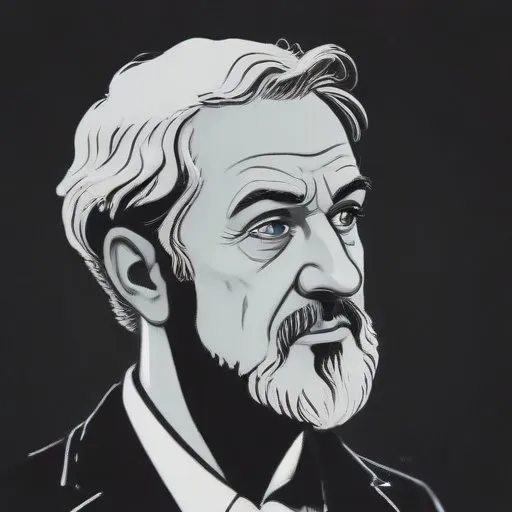
A Greek satirical poet and writer who used humor and irony to critique social and political issues of his time, leaving a lasting impact on Greek literature.
Andreas Laskaratos, a renowned Greek satirical poet and writer, is best known for his provocative works that targeted the hypocrisy of the Greek Orthodox Church, leading to his excommunication. Born on May 1, 1811, on the Ionian island of Cefalonia, Laskaratos was a fearless critic who used his pen to expose the injustices and corruption of his time.
Laskaratos was born into a wealthy aristocratic family of landowners and studied law in Paris. However, he never pursued a career in law, except when he was in financial need. Instead, he was drawn to literature and poetry, and his studies were influenced by the great poet Andreas Kalvos and Greece's national poet Dionysios Solomos.
Laskaratos made a name for himself as a satirical writer, publishing several newspapers, including Lychnos, which criticized immorality, injustice, and hypocrisy. His witty and biting satire often targeted politicians and their incompetence, earning him both admiration and criticism.
Laskaratos' fearless criticism of the Greek Orthodox Church led to his persecution, arrest, and imprisonment. The church hierarchy was particularly upset by his satire, which they deemed blasphemous, and eventually excommunicated him. Despite this, Laskaratos continued to write, publishing works that ridiculed the church's oppressive policies.
Laskaratos married Penelope Korgialeniou, also from a wealthy family, and had two sons and seven daughters. His niece, Eleni Lambiri, was a talented conductor, librettist, and composer. Despite his tumultuous life, Laskaratos remained devoted to his family and continued to write until his death on July 24, 1901, in Argostoli.
Andreas Laskaratos' legacy is that of a champion of free speech and a fearless critic of oppression. His satirical works continue to inspire and provoke, offering a unique glimpse into the social and political landscape of 19th-century Greece. Today, Laskaratos is celebrated as a pioneer of the Heptanese School literature, a movement that sought to promote democracy, individual freedom, and social justice.
Through his writing, Laskaratos left an indelible mark on Greek literature and culture, paving the way for future generations of writers, poets, and satirists. His courage in the face of adversity and his commitment to his art continue to inspire and motivate us to this day.
Some of Laskaratos' most memorable quotes and sayings include:
Andreas Laskaratos was posthumously awarded the highest honors by the Greek state for his contributions to literature and culture.
Today, Laskaratos' works continue to be celebrated and studied in Greece and around the world, inspiring new generations of writers, poets, and thinkers to speak truth to power and challenge the status quo.
Born in 1836
A pioneering Greek journalist and satirist, known for his scathing critiques of Greek politics and society, which remain influential in Greek literature to this day.
Born in 1859
A leading figure of the Greek literary generation of the 1880s, he wrote influential poetry and plays that explored themes of Greek identity and national revival. His works are considered cornerstones of modern Greek literature.
Born in 1884
A leading figure in the Greek literary revival of the 20th century, known for blending folk traditions with modernist experimentation in his poetry and plays. His work explores themes of identity, mythology, and the human condition.
Born in 1884
A Greek poet and playwright who explored themes of social justice, love, and the human condition through his works, which often blended traditional forms with modernist experimentation.
Born in 1883
A Greek philosopher, author, and playwright who explored the human condition through novels like "Zorba the Greek" and "The Last Temptation of Christ", delving into themes of spirituality, morality, and individualism.
