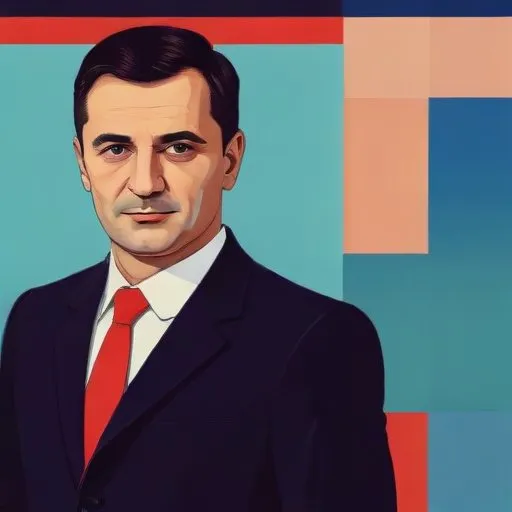
Andrija Artukovi: The Notorious Croatian Lawyer and Politician Behind the Ustasha Movement
A Life of Controversy and Destruction
Andrija Artukovi is known for his involvement in the ultranationalist and fascist Ustasha movement during World War II, serving as the Minister of Internal Affairs and Minister of Justice in the Government of the Independent State of Croatia (NDH). He is infamous for signing into law a number of racial laws against Serbs, Jews, and Roma, leading to the establishment of concentration camps where over 100,000 civilians were tortured and murdered.
Early Life and Education
Born on November 19, 1899, in Klobuk, near Ljubuki in Austro-Hungarian Croatia, Andrija Artukovi was one of 14 siblings raised on a farm. He studied at a Franciscan gymnasium high school in nearby iroki Brijeg and obtained a doctorate in law from the University of Zagreb in 1924. After completing his education, he practiced law in Gospi in the Lika region of the Kingdom of Yugoslavia.
Rise to Power and Ustasha Activities
Artukovi joined the Croatian nationalist and terrorist Ustasha organisation in 1929. In 1932, he was one of the organizers of their small Velebit uprising in Lika, which involved an attack on a Yugoslav gendarmerie station. After fleeing Yugoslavia before the uprising commenced, he was appointed as an adjutant to Main Ustaa Headquarters and commander of all Ustae in Italy by Ante Paveli, the supreme leader of the Ustae. Artukovi adopted the pseudonym "Hadija" or "pilgrim" during this time.
Minister of Internal Affairs and Minister of Justice
During World War II, Artukovi served as the Minister of Internal Affairs and Minister of Justice in the Government of the Independent State of Croatia (NDH). He signed into law a number of racial laws against Serbs, Jews, and Roma, leading to the establishment of concentration camps where over 100,000 civilians were tortured and murdered. His brutal actions earned him the reputation as one of the most notorious figures of the Ustasha regime.
Escape and Extradition
After the war, Artukovi escaped to the United States, where he lived until he was extradited to Yugoslavia in 1986. He was tried and found guilty of a number of mass killings in the NDH. Although he was sentenced to death, the sentence was not carried out due to his age and health. He died in custody on January 16, 1988.
Legacy of Destruction
Andrija Artukovi's involvement in the Ustasha movement and his role in the NDH government led to the torture and murder of hundreds of thousands of innocent civilians. His brutal actions left a lasting impact on the people of Yugoslavia and served as a dark reminder of the dangers of nationalism and fascism.
Personal Milestones and Key Life Events
- 1899: Born on November 19th in Klobuk, near Ljubuki in Austro-Hungarian Croatia
- 1924: Obtained a doctorate in law from the University of Zagreb
- 1926: Practiced law in Gospi in the Lika region of the Kingdom of Yugoslavia
- 1932: Organized the Velebit uprising in Lika
- 1941-1945: Served as Minister of Internal Affairs and Minister of Justice in the Government of the Independent State of Croatia (NDH)
- 1986: Extradited to Yugoslavia
- 1988: Died on January 16th in custody
Controversies and Public Perception
Andrija Artukovi's involvement in the Ustasha movement and his role in the NDH government has been widely condemned. His brutal actions and discriminatory laws have left a lasting impact on the people of Yugoslavia and serve as a reminder of the dangers of nationalism and fascism.
FAQ
Who was Andrija Artuković in the Croatian government?
Andrija Artuković was the Croatian Minister of Interior during World War II, serving from 1941 to 1945. He was responsible for implementing the Ustaše regimes policies, including the persecution of Serbs, Jews, and Roma.
What was Andrija Artukovićs role in the Ustaše regime?
Andrija Artuković was one of the key figures in the Ustaše regime, responsible for enforcing the regimes policies, including the establishment of concentration camps and the persecution of minorities.
Did Andrija Artuković face trial for war crimes?
Andrija Artuković escaped to Spain after the war and lived in exile until 1986, when he was extradited to Yugoslavia to face trial for war crimes. He was sentenced to death but died in prison in 1988.
What was the impact of Andrija Artukovićs policies?
Andrija Artukovićs policies as Minister of Interior led to the deaths of tens of thousands of people, including Serbs, Jews, and Roma, and are considered some of the darkest chapters in Croatian history.
How is Andrija Artuković remembered today?
Andrija Artuković is widely regarded as a war criminal and a key figure in the Ustaše regimes atrocities. His legacy serves as a reminder of the dangers of extremism and the importance of protecting human rights.