


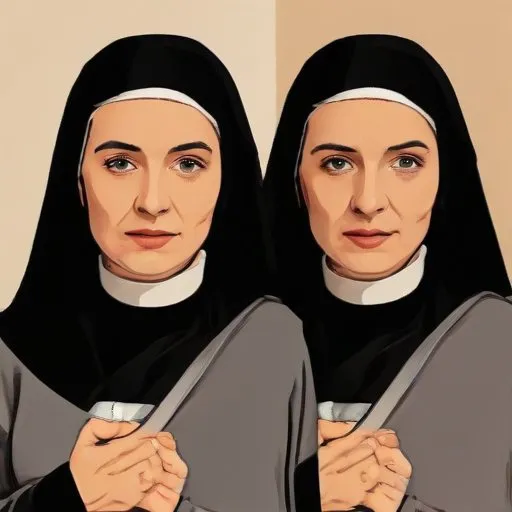
A German nun who risked her life to help Jewish prisoners in Auschwitz, ultimately sacrificing herself in the process. Her selfless acts of kindness and bravery in the face of unimaginable evil are a testament to her remarkable character.
Angela Maria Autsch, a German Trinitarian Sister of Valencia, is renowned for her bravery and dedication to her faith during the tumultuous era of World War II. Her remarkable story of standing up against the Nazi regime, even in the face of imprisonment, has inspired generations and earned her the title of a heroic martyr.
Born Maria Cecilia Autsch on March 26, 1900, in Rüllen, part of Attendorn in the Olpe district of Westphalia, German Empire, she grew up in a modest working-class family. Her father, a quarry worker, instilled in her the values of the Catholic faith, which would later become the driving force of her life.
After completing her education in the village of Bamenohl, Angela worked in a clothing store in Finnentrop, where her kind nature and strong work ethic made her a beloved figure among her colleagues and customers.
At the age of 33, Angela joined the Trinitarian Sisters of Valencia in Mätz, Austria, where she took the name Angela Maria of the Sacred Heart of Jesus. She began her novitiate and made her first profession of vows on August 16, 1934. Her final profession took place on September 28, 1938, a year that would mark a significant turning point in her life.
As the Nazi party attempted to expropriate the Mätz monastery, Angela successfully intervened, arguing that the Tyrolean monastery was Spanish property. This courageous act would be the first of many that would showcase her unwavering commitment to her faith and her order.
On August 10, 1940, Angela's life took a drastic turn. While on an errand to buy milk, she engaged in a conversation with some acquaintances, during which she mentioned the Allies' sinking of a German ship off Norway and expressed her opinion that Hitler was a calamity for Europe. Unbeknownst to her, one of the women was a Nazi sympathizer, who reported her comments to the Gestapo.
Angela was arrested on August 12, 1940, and imprisoned for 17 days in Innsbruck before being transferred to the notorious Ravensbrück concentration camp, where she became prisoner no. 4651.
Angela Maria Autsch's bravery and devotion in the face of adversity have inspired countless individuals. Her beatification process was opened in 1992, a testament to her extraordinary life and martyrdom.
Today, Angela's story serves as a powerful reminder of the importance of standing up for one's principles, even in the face of overwhelming opposition. Her selflessness, compassion, and unwavering commitment to her faith continue to inspire generations, cementing her place as a hero of the Catholic Church.
Born in 1891
A Polish nun who converted from Judaism and was martyred in Auschwitz, known for her philosophical writings and devotion to God. She's a symbol of faith and resilience in the face of persecution.
Born in 1871
A pioneering Marxist theorist and activist who advocated for workers' rights and criticized capitalism, known for her radical ideas on revolution and democracy.
Born in 1857
A pioneering Marxist theorist and women's rights activist who played a key role in shaping socialist and feminist movements in early 20th-century Europe.
Born in 1867
A pioneering scientist who pioneered radioactivity research, discovering elements polonium and radium, and paving the way for breakthroughs in medicine and energy.
Born in 1867
A pioneering artist who captured the human cost of war and poverty through powerful, emotive works, often featuring mothers and children. Her prints and sculptures continue to evoke strong emotions and spark social commentary.
