


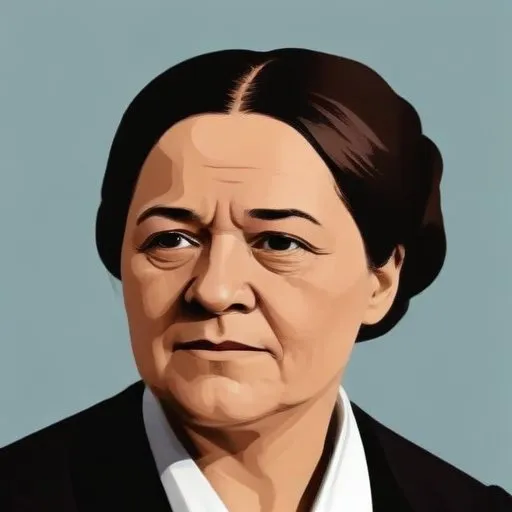
A pioneering Marxist theorist and women's rights activist who played a key role in shaping socialist and feminist movements in early 20th-century Europe.
Clara Zetkin was a German Marxist theorist, communist activist, and pioneering advocate for women's rights, leaving an indelible mark on the history of socialism and feminism. Born on July 5, 1857, in Wiederau, Saxony, Zetkin dedicated her life to fighting for the rights of the working class and women, becoming a prominent figure in the Social Democratic Party of Germany and later the Communist Party of Germany.
Zetkin was born into a modest family, with her father, Gottfried Eissner, serving as a schoolmaster, church organist, and devout Protestant. Her mother, Josephine Vitale, had French roots and came from a middle-class family in Leipzig. Zetkin's early life was marked by her family's move to Leipzig in 1872, where she attended the Leipzig Teachers College for Women. It was during this time that she established connections with the infant Social Democratic Party of Germany.
Zetkin's involvement in socialist activity led to her exile in Paris in 1882, where she studied journalism and translation. It was in Paris that she played a crucial role in the foundation of the Socialist International group and adopted the name of her lover, Ossip Zetkin, a devoted Marxist. After Ossip's death in 1889, Zetkin moved to Stuttgart with her two sons, Maxim and Konstantin.
Zetkin's political career spanned several decades, during which she was an active member of the Social Democratic Party of Germany until 1917. She then joined the Independent Social Democratic Party of Germany (USPD) and its far-left wing, the Spartacist League, which later became the Communist Party of Germany (KPD). Zetkin represented the KPD in the Reichstag during the Weimar Republic from 1920 to 1933.
Zetkin was a vocal advocate for women's rights, believing that women's liberation was inextricably linked to the socialist revolution. She organized the first International Women's Day in 1911, which was later adopted by the United Nations in 1975. Her pioneering work in this area earned her recognition as a leading figure in the women's movement.
Zetkin married artist Georg Friedrich Zundel in 1899, who was eighteen years her junior. The marriage lasted until 1928. Throughout her life, Zetkin remained committed to her ideals, often at great personal cost. Her unwavering dedication to the socialist cause and women's rights earned her both admiration and criticism from her contemporaries.
Clara Zetkin's legacy extends far beyond her own lifetime. She played a significant role in shaping the course of socialism and feminism in Germany and beyond. Her tireless advocacy for women's rights and her commitment to the socialist cause continue to inspire generations of activists and scholars.
Clara Zetkin's remarkable life and achievements serve as a testament to her unwavering commitment to social justice and women's empowerment. As a pioneering figure in the history of socialism and feminism, her legacy continues to inspire and motivate individuals around the world.
Born in 1871
A pioneering Marxist theorist and activist who advocated for workers' rights and criticized capitalism, known for her radical ideas on revolution and democracy.
Born in 1818
A 19th-century philosopher who developed the theory of communism, arguing that capitalism would eventually be replaced by a socialist society. He's known for his critique of capitalism and the concept of class struggle.
Born in 1820
A 19th-century philosopher and economist who co-authored "The Communist Manifesto" with Karl Marx, shaping modern socialist and communist thought. He also wrote extensively on economics, history, and politics.
Born in 1870
Founder of the world's first socialist state, leading the Bolshevik Revolution and establishing the Soviet Union, known for his radical Marxist ideology and authoritarian rule.
Born in 1879
Founded the Red Army and played a crucial role in the Russian Revolution, shaping the course of modern communism. A key figure in 20th-century politics and ideology.
Born in 1878
The Soviet Union's ruthless leader who ruled with an iron fist, implementing policies that led to widespread famine and purges, while also playing a crucial role in defeating Nazi Germany in World War II.
Born in 1893
Leader of the Chinese Communist Party who implemented radical social and economic reforms, including the Great Leap Forward and the Cultural Revolution, shaping modern China's politics and economy.
Born in 1926
The Cuban revolutionary who led the country from 1959 to 2008, implementing socialist policies and defying US opposition, becoming an iconic figure in modern history.
