


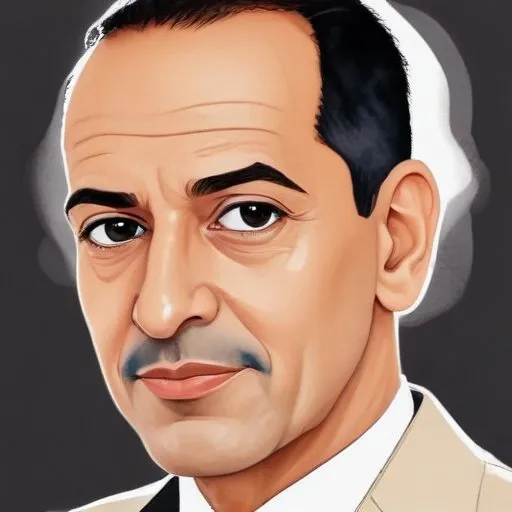
Egyptian journalist and author, known for his influential writings on Arabic literature and politics, as well as his role in shaping Egypt's cultural identity.
Anis Mansour, a renowned Egyptian writer, is best known for his remarkable journey around the world, which he documented in his iconic book, "Around the World in 200 Days." This literary masterpiece not only showcased his travel adventures but also introduced Arab readers to the diverse cultures, traditions, and ways of life beyond their borders.
Born on August 18, 1924, in Al Mansoura, Egypt, Mansour's passion for words and exploration led him to pursue a degree in philosophy from Cairo University in 1947. He soon began his journalistic career, working with prominent newspapers and magazines, including Al Asas, Rose al-Yousef, and Al-Ahram.
Mansour's versatility as a writer and editor led him to hold esteemed positions, such as editor-in-chief of Akher Saa (1970-1976) and October magazine (1976). He authored an impressive 170 books on various subjects, many of which were translated into French, Dutch, and Russian. His translations of over 200 short stories and 20 plays into Arabic introduced Arab readers to global literature, including the works of Alberto Moravia.
Mansour's most famous book, "Around the World in 200 Days," is a testament to his adventurous spirit and thirst for knowledge. In the early 1960s, he embarked on a journey to circumnavigate the globe, visiting countries like India, Japan, Australia, and the United States. The book, which documented his experiences, offered Arab readers a unique window into the world beyond their borders. His encounters with diverse cultures, traditions, and notable figures, such as the Dalai Lama, enriched the narrative, making it a timeless classic.
Anis Mansour's contributions to Arabic literature and journalism are immeasurable. Through his writings, he bridged the cultural gap between the Arab world and the global community, promoting cross-cultural understanding and exchange. His legacy continues to inspire generations of writers, travelers, and thinkers, cementing his place as one of Egypt's most revered literary figures.
Mansour's writings reflect his deep appreciation for the diversity of human experiences and cultures. Through his work, he promoted the values of tolerance, understanding, and open-mindedness, encouraging his readers to embrace the richness of global perspectives.
Anis Mansour's literary contributions have had a lasting impact on Arabic literature and journalism. His writings have influenced generations of writers, thinkers, and travelers, shaping the way Arabs perceive and interact with the world beyond their borders.
Born in 1911
Renowned Egyptian literary mastermind behind rich, poignant novels and plays that explore the human condition, earning the Nobel Prize in Literature in 1988.
Born in 1898
A pioneer of Arabic literature, he crafted plays and novels that explored the human condition, blending traditional Egyptian culture with modernist themes. His works continue to influence Middle Eastern literature and theatre.
Born in 1918
Led Egypt through a period of rapid modernization and nationalism, becoming a symbol of Arab unity and resistance to Western influence. He nationalized the Suez Canal and implemented socialist reforms.
71 Years Old
Egypt's sixth president, a military leader who seized power in a coup, known for his authoritarian rule and human rights abuses. He has dominated Egyptian politics since 2013.
74 Years Old
Egypt's first democratically elected president, who served from 2012 to 2013 and was a key figure in the Arab Spring uprising, known for his Islamist ideology and brief, tumultuous tenure.
98 Years Old
The authoritarian leader who ruled Egypt for nearly three decades, suppressing opposition and maintaining a tight grip on power, while also maintaining a delicate balance of power in the Middle East. He's infamous for his regime's human rights abuses and corruption.
