


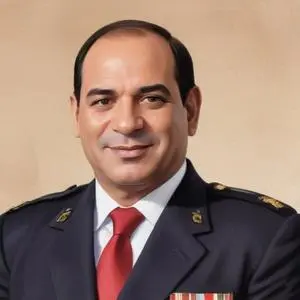
Egypt's sixth president, a military leader who seized power in a coup, known for his authoritarian rule and human rights abuses. He has dominated Egyptian politics since 2013.
Abdel Fattah el-Sisi, the sixth and current President of Egypt, is a name synonymous with power, resilience, and reform. As a seasoned military officer turned statesman, el-Sisi has left an indelible mark on the country's politics, economy, and society, earning him both admiration and criticism from Egyptians and the international community alike.
Born on November 19, 1954, in Cairo, Egypt, el-Sisi's early life was marked by a strong sense of patriotism and a desire to serve his country. He joined the Egyptian Army and went on to hold various posts, including a stint in Saudi Arabia, before enrolling in the Egyptian Army's Command and Staff College.
El-Sisi's military career saw him receive additional training at the Joint Services Command and Staff College in the United Kingdom in 1992 and at the United States Army War College in Carlisle, Pennsylvania, in 2006. He rose through the ranks, becoming a mechanized infantry commander and eventually, the Director of Military Intelligence in 2010.
El-Sisi's meteoric rise to power began in 2012 when he was appointed Minister of Defense by then-President Mohamed Morsi. As the commander-in-chief of the Egyptian Armed Forces, el-Sisi played a pivotal role in the ousting of Morsi in 2013, following widespread protests against his rule.
In the aftermath of Morsi's downfall, el-Sisi became the de facto leader of Egypt, overseeing the transitional period and eventually winning the presidential election in 2014 with a landslide victory.
As President, el-Sisi has implemented a series of reforms aimed at reviving Egypt's economy, improving security, and promoting social justice. Some of his notable initiatives include:
Despite his popularity, el-Sisi's presidency has been marred by controversy, with critics accusing him of suppressing political dissent, restricting civil liberties, and perpetuating human rights abuses.
The dispersal of pro-Morsi sit-ins in 2013, which resulted in hundreds of deaths, remains a contentious issue, with many holding el-Sisi responsible for the violence.
Little is known about el-Sisi's personal life, with the President preferring to keep his family and personal beliefs out of the public eye. However, his strong sense of patriotism and commitment to Islamic values are well-documented.
In a rare glimpse into his personal life, el-Sisi has spoken about the importance of faith in his life, stating, "I believe that God has chosen me for this mission, and I will not disappoint Him."
Love him or hate him, Abdel Fattah el-Sisi has left an indelible mark on modern Egypt. His presidency has been marked by significant reforms, infrastructure development, and a renewed sense of national pride.
As Egypt navigates the complexities of the 21st century, el-Sisi's leadership will continue to shape the country's trajectory, with the President's vision for a more prosperous, stable, and secure Egypt serving as a beacon of hope for millions of Egyptians.
Net Worth: Estimated to be around $1 billion, largely due to his military pension and presidential salary.
Philosophical Contributions and Beliefs: El-Sisi is known for his strong sense of patriotism and commitment to Islamic values.
Personal Milestones and Key Life Events: Married to Entissar Amer, with four children, el-Sisi's personal life has been marked by a strong sense of family and faith.
Influence on Modern Society: El-Sisi's presidency has had a profound impact on Egyptian society, with his reforms and initiatives shaping the country's economic, political, and social landscape.
Career Highlights and Major Works: El-Sisi's presidency has been marked by significant achievements, including the construction of the New Suez Canal and the establishment of the New Administrative Capital.
75 Years Old
Egypt's first democratically elected president, who served from 2012 to 2013 and was a key figure in the Arab Spring uprising, known for his Islamist ideology and brief, tumultuous tenure.
98 Years Old
The authoritarian leader who ruled Egypt for nearly three decades, suppressing opposition and maintaining a tight grip on power, while also maintaining a delicate balance of power in the Middle East. He's infamous for his regime's human rights abuses and corruption.
Born in 1918
Led Egypt through a period of rapid modernization and nationalism, becoming a symbol of Arab unity and resistance to Western influence. He nationalized the Suez Canal and implemented socialist reforms.
80 Years Old
A transitional leader who served as President of Egypt after the 2013 coup, known for stabilizing the country and overseeing a new constitution. He played a crucial role in Egypt's political transition.
72 Years Old
The 12th President of Turkey, a dominant figure in Turkish politics, known for his Islamist roots and authoritarian leadership style, shaping Turkey's modern political landscape.
74 Years Old
A Russian politician who has dominated the country's politics for over two decades, known for his authoritarian leadership style and controversial foreign policy decisions.
