


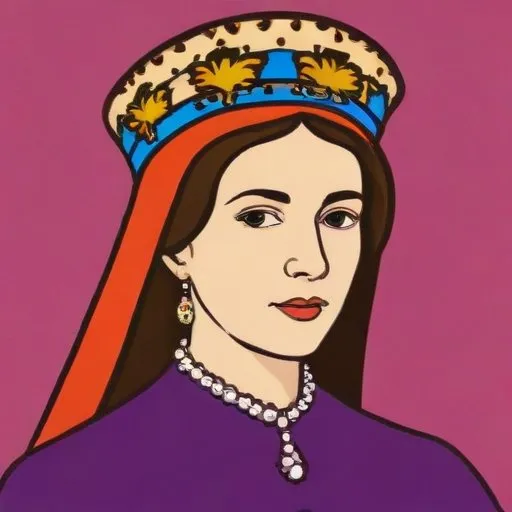
A Duchess of Savoy in the 15th century, known for her royal marriage and potential claims to the throne of Cyprus. She played a significant role in European royal politics during her lifetime.
Anne of Cyprus, also known as Anne de Lusignan, was a Duchess of Savoy by marriage to Louis, Duke of Savoy, and is renowned for her exceptional diplomatic and political prowess, which earned her the reputation of being a shrewd and effective ruler.
As the daughter of King Janus of Cyprus and Charlotte of Bourbon, Anne was a member of the esteemed Poitiers-Lusignan crusader dynasty, and her marriage to Louis in 1434 catapulted her to a position of significant influence in the Duchy of Savoy.
Born on 24 September 1418, Anne's life was marked by a series of significant events that shaped her future. At the tender age of 12, a marriage contract was signed between her and Prince Amadeus of Piedmont, eldest surviving son and heir of Duke Amadeus VIII of Savoy, but the prince's untimely death just twenty days later led to a second marriage contract with Louis, Amadeus's younger brother and new heir of the Duchy of Savoy.
Following her marriage to Louis in 1434, Anne's husband, who was more interested in poetry than governance, gradually entrusted her with the management of state affairs. This marked the beginning of Anne's remarkable rise to power and influence, as she utilized her natural aptitude for politics and diplomacy to navigate the complexities of the Duchy of Savoy.
As a nostalgic reminder of her Cypriot heritage, Anne organized lavish receptions for prominent Cypriot lords, which included the decoration of castles, festivals, and gift-giving to guests. While these extravagances incited protests from the peasants and nobles of the county of Vaud due to the mounting expenses, Anne's diplomatic efforts earned her a reputation as a shrewd and capable leader.
Anne of Cyprus's remarkable life and achievements have left an indelible mark on history, demonstrating that women could wield considerable power and influence in a predominantly patriarchal society. Her diplomatic prowess, strategic thinking, and effective governance have inspired generations of women in leadership positions, cementing her place as a trailblazing figure in the annals of history.
Anne's life and reign were shaped by the complexities of the medieval period, marked by the decline of the crusader states and the rise of powerful nation-states in Europe. Her ability to navigate these complexities and forge strategic alliances has earned her a place among the most influential women of the medieval era, alongside notable figures such as Joan of Arc and Isabella of Castile.
Through her remarkable life and achievements, Anne of Cyprus has left an enduring legacy, one that continues to inspire and educate generations about the importance of diplomacy, politics, and effective governance.
Born in 1413
A 15th-century nobleman who ruled Savoy and Piedmont, known for his military campaigns and territorial expansions in the Italian Wars. He played a significant role in shaping the region's history and politics.
Born in 1489
An Italian nobleman who ruled Savoy from 1504 to 1533, known for his military campaigns and territorial expansions, particularly in the Italian Wars. He played a significant role in shaping the region's history.
Born in 1480
Governor of the Habsburg Netherlands, she was a skilled politician and diplomat who played a key role in maintaining peace and stability in the region during a tumultuous period.
Born in 1504
A Portuguese princess who married into the House of Savoy and played a significant role in the politics of 14th-century Italy, particularly in the Duchy of Savoy.
