


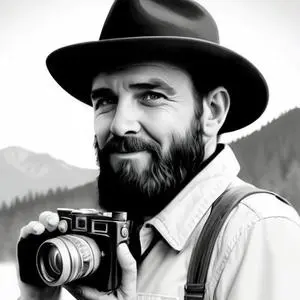
Pioneering landscape photographer and conservationist capturing iconic black-and-white images of the American West, advocating for environmental protection through art.
Ansel Adams is synonymous with the majestic landscapes of the American West, his iconic black-and-white photographs capturing the essence of nature's grandeur. As a pioneer of landscape photography, Adams' work not only redefined the art form but also inspired a generation of environmentalists to preserve the natural beauty of the American wilderness.
Born on February 20, 1902, in San Francisco, California, Adams was introduced to photography at the tender age of 14 during a family vacation to Yosemite National Park. This encounter sparked a lifelong passion, and he soon became an avid member of the Sierra Club, a environmental organization dedicated to preserving the American wilderness.
Adams' photographic journey took a significant turn when he co-developed the Zone System, a revolutionary technique that enabled photographers to achieve a desired final print through a deep understanding of exposure, negative development, and printing. This innovation led to the formation of Group f/64, an association of photographers advocating for "pure photography" with sharp focus and a full tonal range.
Adams' photography was deeply entwined with his environmental ethos. Through his work, he aimed to inspire a sense of responsibility towards nature and promote conservation. His efforts led to numerous collaborations with the United States Department of the Interior, resulting in the expansion of the National Park system.
In recognition of his tireless advocacy and contribution to photography, Adams was awarded the Presidential Medal of Freedom in 1980, the highest civilian honor in the United States.
Adams played a pivotal role in establishing the photography department at the Museum of Modern Art in New York, a milestone that secured photography's institutional legitimacy. He also co-founded the photography magazine Aperture and helped establish the Center for Creative Photography at the University of Arizona.
Adams' personal life was marked by significant milestones, including his marriage to Virginia Best and the birth of their son, Michael. He was known for his wit and humor, often incorporating these qualities into his teaching and public appearances.
Despite his immense popularity, Adams faced criticism for his perceived elitism and exclusivity within the Group f/64 circle. Additionally, some of his photographs were deemed controversial due to the manipulation of tones and contrast.
Ansel Adams' work has had a profound impact on modern society, inspiring generations of environmentalists, photographers, and artists. His advocacy for conservation has contributed significantly to the preservation of the American wilderness, while his photographic innovations continue to influence the medium.
Adams believed that photography could be a powerful tool for environmental education and advocacy. He saw the natural world as a source of spiritual renewal and believed that his work could inspire a deeper appreciation for the beauty and fragility of nature.
"You don't take a photograph, you make it."
Ansel Adams' legacy extends beyond his photographs, representing a cultural and environmental movement that continues to shape American society. His work serves as a beacon, inspiring future generations to cherish and protect the natural world.
Born in 1895
Documented the lives of those affected by the Great Depression and the Dust Bowl through powerful, poignant photographs that humanized the struggles of the era. Captured iconic images that shaped the national conversation around poverty and social justice.
Born in 1879
A pioneering photographer and painter who blurred the lines between art and commerce, capturing iconic images for Vogue and Harper's Bazaar while pushing the boundaries of modern art.
Born in 1864
A pioneering photographer and curator who promoted modern art in the early 20th century, showcasing works by avant-garde artists like Georgia O'Keeffe and Henri Matisse.
Born in 1887
Pioneering American modernist artist famous for bold, colorful depictions of enlarged flowers, landscapes, and abstract compositions that explored new ways of representing the American Southwest. Her innovative style and independence inspired generations of artists.
Born in 1883
Pioneering photographer capturing intimate botanicals, industrial landscapes, and portraits, pushing boundaries of modernist photography.
Born in 1908
A pioneer of modern photography, capturing the spiritual and emotional essence of everyday scenes, and a influential educator who shaped the development of photography as an art form.
