


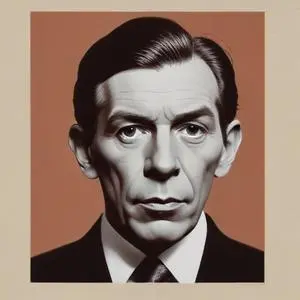
A renowned art historian who led a secret life as a Soviet spy, betraying his country by passing classified information to the KGB. His espionage activities were only discovered in 1979, sparking a national scandal.
Anthony Blunt was a renowned British art historian, professor, and curator who led a double life as a Soviet spy, making him one of the most intriguing figures of the 20th century. His remarkable career was marked by significant contributions to the field of art history, as well as his clandestine activities as a member of the infamous Cambridge Five.
Blunt was born on September 26, 1907, in Bournemouth, Hampshire, to Revd Arthur Stanley Vaughan Blunt and Hilda Violet Master. He was the third and youngest son in a family of modest means. Blunt's early life was marked by a strong interest in art and history, which led him to pursue higher education in these fields.
Blunt's academic career was nothing short of remarkable. He graduated from Cambridge University in 1930 and went on to become a professor of art history at the University of London. He also served as the director of the Courtauld Institute of Art and Surveyor of the Queen's Pictures. His 1967 monograph on Nicolas Poussin is still widely regarded as a seminal work in art history.
Blunt's teaching text and reference work, Art and Architecture in France 1500–1700, first published in 1953, reached its fifth edition in 1999 and remains a benchmark in the field. His expertise in French art and architecture earned him recognition and respect among his peers.
In 1964, Blunt confessed to having been a spy for the Soviet Union, making him the fourth member of the Cambridge Five to be exposed. This group of Cambridge-educated spies worked for the Soviet Union from the 1930s to the early 1950s, passing sensitive information to the Soviet government.
Blunt's espionage activities peaked during World War II, when he passed intelligence about Wehrmacht plans to the Soviets. This information was deliberately withheld from the British government's ally, making his actions even more treasonous.
Blunt's confession was kept secret for years, but in 1979, Prime Minister Margaret Thatcher publicly revealed his identity as a Soviet spy. He was stripped of his knighthood immediately thereafter. Historian Andrew Boyle had already exposed Blunt's espionage activities in print earlier that year.
Blunt's remarkable career was marred by his clandestine activities, which have overshadowed his significant contributions to art history. While his academic work remains highly regarded, his actions as a spy have sparked controversy and debate about loyalty, patriotism, and the ethics of espionage.
Despite the controversy surrounding his life, Blunt's legacy continues to fascinate and intrigue art historians, espionage enthusiasts, and anyone interested in the complexities of human nature.
“The greatest happiness of life is the conviction that we are loved; loved for ourselves, or rather, loved in spite of ourselves.” — Anthony Blunt
Born in 1912
A high-ranking member of British intelligence who defected to the Soviet Union, revealing secrets and compromising national security. Known for being a notorious double agent during the Cold War.
Born in 1911
A high-ranking member of the British intelligence community who defected to the Soviet Union, notorious for betraying his country and compromising national security.
Born in 1911
A German-born physicist who contributed significantly to the development of the atomic bomb, while secretly passing nuclear secrets to the Soviet Union during the Cold War.
Born in 1912
Pioneering mathematician and computer scientist who cracked the German Enigma code during WWII and laid the foundations for modern computer science and artificial intelligence.
