


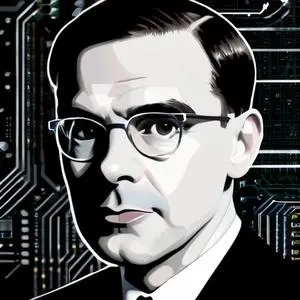
Pioneering mathematician and computer scientist who cracked the German Enigma code during WWII and laid the foundations for modern computer science and artificial intelligence.
Alan Turing, a British mathematician, computer scientist, and logician, is widely regarded as the father of theoretical computer science and artificial intelligence. He is best known for his work in developing the concept of the universal Turing machine, which laid the foundation for modern computer architecture.
Turing was born on June 23, 1912, in London, England. He was raised in southern England and showed a strong affinity for mathematics from an early age. Turing attended King's College, Cambridge, where he graduated with a degree in mathematics in 1934. He later earned his Ph.D. in mathematics from Princeton University in 1938.
During World War II, Turing worked at the Government Code and Cypher School (GC&CS) at Bletchley Park, Britain's top-secret codebreaking center. He led Hut 8, the section responsible for German naval cryptanalysis, and developed techniques for speeding up the breaking of German ciphers. Turing's work, including improvements to the pre-war Polish bomba method, played a crucial role in cracking intercepted messages, enabling the Allies to defeat the Axis powers in several key engagements, including the Battle of the Atlantic.
After the war, Turing worked at the National Physical Laboratory (NPL), where he designed the Automatic Computing Engine (ACE), one of the first designs for a stored-program computer. In 1948, Turing joined Max Newman's Computing Machine Laboratory at the University of Manchester, where he helped develop the Manchester computers and became interested in mathematical biology.
Turing's work extended beyond computer science to philosophy, where he made significant contributions to the concept of artificial intelligence. He proposed the Turing Test, a measure of a machine's ability to exhibit intelligent behavior equivalent to, or indistinguishable from, that of a human. Turing's philosophical ideas also explored the concept of machine intelligence, free will, and the limits of human knowledge.
Turing's contributions to computer science and artificial intelligence have had a profound impact on modern society. His work laid the foundation for the development of modern computers, programming languages, and artificial intelligence. Turing's legacy extends beyond technology, as his ideas continue to influence philosophy, cognitive science, and our understanding of human intelligence.
"Can machines think?"
"The question of whether machines can think is too meaningless to be discussed."
Turing's work took place in the context of World War II and the Cold War, where codebreaking and computational power played critical roles in national security. Turing's contributions have been recognized posthumously, with numerous awards, honors, and recognition for his pioneering work. In 2009, the British government officially apologized for Turing's treatment and persecution.
Turing's contemporaries, such as Kurt Gödel, Alonzo Church, and Marvin Minsky, made significant contributions to computer science and artificial intelligence. While their work differed in focus and approach, Turing's emphasis on the theoretical foundations of computation and the concept of the universal Turing machine set him apart as a pioneer in the field.
Turing's life and work serve as a testament to the power of human ingenuity and determination. Despite facing persecution and adversity, Turing remained dedicated to his work, driven by a passion for understanding the fundamental nature of computation and intelligence.
Alan Turing's legacy continues to inspire new generations of computer scientists, philosophers, and thinkers, ensuring that his work will remain a cornerstone of modern technology and intellectual inquiry.
Born in 1906
A British mathematician and computer scientist who played a crucial role in cracking the German Enigma code during World War II, and later wrote about his experiences.
Born in 1917
Noted baseball player and scout who played for several teams and later discovered talented players like Lou Brock and Lee Smith. Known for his keen eye for talent and contributions to the game.
Born in 1917
A brilliant codebreaker and coin enthusiast who helped crack the German Enigma code during WWII, making significant contributions to Allied victory.
Born in 1911
A Soviet chess grandmaster and engineer who dominated the game from the 1940s to 1960s, winning six World Chess Championships and developing the first chess-playing computer program.
Born in 1924
A renowned author and critic who explored Japanese culture, film, and literature, offering insightful perspectives on the country's art and society.
96 Years Old
A renowned television and film director, producer, and screenwriter, best known for his work on British television dramas, including the acclaimed "Manhunt" series.
Born in 1923
A renowned physicist and mathematician who made groundbreaking contributions to quantum electrodynamics and futurism, proposing innovative ideas like the Dyson sphere.
