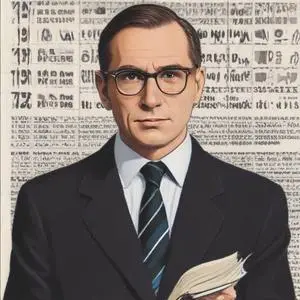
Gordon Welchman: The Unsung Hero of Bletchley Park
Breaking Enemy Codes and Securing Allied Victory
Gordon Welchman, a British mathematician, is renowned for his pivotal role in deciphering enemy codes during World War II. Alongside
Alan Turing,
Hugh Alexander, and Stuart Milner-Barry, Welchman formed the core team of codebreakers at Bletchley Park, the British intelligence center responsible for cracking the German Enigma code.
Early Life and Education
Born on June 15, 1906, in Fishponds, Bristol, Welchman was the youngest of three children to William Welchman, a Church of England priest, and Elizabeth Marshall Griffith. He was educated at Marlborough College and later studied mathematics at Trinity College, Cambridge, from 1925 to 1928. Welchman became a Research Fellow in Mathematics at Sidney Sussex College, Cambridge, in 1929, eventually becoming a Fellow in 1932 and Dean of the College.
The Enigma Codebreaker
As World War II loomed, Welchman was recruited by Commander Alastair Denniston to join the Government Code and Cypher School (GCCS) at Bletchley Park. Here, Welchman's exceptional analytical mind and mathematical prowess made him an invaluable asset in the decryption of enemy encrypted messages. He worked closely with his fellow codebreakers, collectively known as the "Wicked Uncles," to break the German Enigma code, a feat that significantly contributed to the Allied victory.
Traffic Analysis and the Battle of the Atlantic
Welchman's expertise in traffic analysis, the collection and analysis of data about enemy units, played a crucial role in understanding the German naval communications. This breakthrough enabled the Allies to anticipate and counter German U-boat attacks, ultimately turning the tide of the Battle of the Atlantic.
A Letter to Winston Churchill
In October 1941, Welchman, along with his fellow codebreakers, signed a letter to
Winston Churchill requesting additional resources for the codebreaking work at Bletchley Park. Churchill's prompt response, marked "Action This Day," ensured the necessary support for the team's efforts.
Post-War Career and Legacy
After the war, Welchman moved to the United States, where he worked on the design of military communications systems. He remained in the US until his death on October 8, 1985. Welchman's contributions to codebreaking and his role in the Allied victory are now recognized as instrumental, earning him a place in history alongside his esteemed colleagues.
Awards and Honors
Welchman was appointed an Officer of the Order of the British Empire (OBE) in 1971 for his services to cryptography.
Personal Milestones and Key Life Events
- 1929: Became a Research Fellow in Mathematics at Sidney Sussex College, Cambridge
- 1932: Became a Fellow of Sidney Sussex College, Cambridge
- 1941: Signed a letter to Winston Churchill requesting additional resources for codebreaking work at Bletchley Park
- 1948: Moved to the United States
- 1971: Appointed an Officer of the Order of the British Empire (OBE)
- 1985: Passed away on October 8
Historical Context and Legacy
Gordon Welchman's work at Bletchley Park not only contributed to the Allied victory in World War II but also paved the way for modern cryptography and codebreaking. His legacy, though often overshadowed by that of his colleague Alan Turing, is now recognized as a vital part of the codebreaking effort.
FAQ
What was Gordon Welchmans role in codebreaking during World War II?
Gordon Welchman was a key figure in the British codebreaking effort at Bletchley Park during World War II, where he worked on breaking German and Italian codes.
What was Gordon Welchmans most significant contribution to codebreaking?
Gordon Welchmans most significant contribution to codebreaking was his development of the diagonal board, a technique for breaking the German Enigma code.
How did Gordon Welchmans work impact the war effort?
Gordon Welchmans work had a significant impact on the war effort, providing the Allies with vital intelligence on German military operations and helping to shorten the war.
What was Gordon Welchmans background and education?
Gordon Welchman was born in 1903 in Ruardean, England. He studied mathematics at Cambridge University and later earned his Ph.D. in mathematics from Princeton University.
What awards did Gordon Welchman receive for his work in codebreaking?
Gordon Welchman received several awards for his work in codebreaking, including the Order of the British Empire and the US Medal for Freedom.